I'm not saying it's the one and only factor (not even sure how much it actually count, numerically), I'm just saying that automatically equating “births in religious families in France” to “traditional catholic families” is too much of a shortcut.
France has ~9mil, Germany has ~6mil, the UK has ~6mil, all comparable. France percentage-wise is also about the same as Bulgaria or Sweden. That doesn't sound like a massive differentiator, with all these other countries hovering around 1.5
I presume this is because the causal factor is women’s independence, specifically financial independence. Perhaps Muslim immigrants in some countries have women with more independence resulting in lower fertility rates, whereas Muslim immigrants in other countries have women with less independence, resulting in higher fertility rates.
People can be nominally Catholic without doing a particularly good job of actually believing in and practicing the tenets of the religion. In fact, this is sort of the rule rather than the exception in much of Europe and North America.
The way to think about this is that people affiliate themselves with tribes for multiple reasons.
One can philosophically not care at all about the beliefs of Catholicism, Judaism, Islam, Hinduism, etc, but for the purposes of interacting with members of their tribe, and signaling to other members of their tribe that they are in that tribe, they might still describe themselves as being “Catholic” (or whatever).
Exactly, and it’s reinforced by the fact that the two main ethnic groups in France (“ethnically French”, and North African Arabs), are distinguished by religion: the former are mostly Catholic, and the latter are virtually all Muslims. So the lines between religion and other markers of identity are blurred.


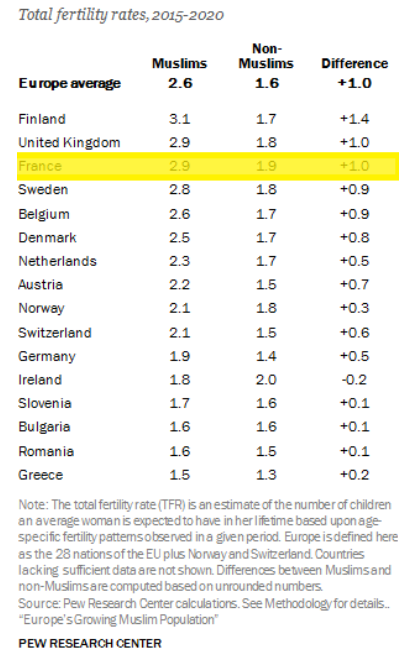
So religion can be a factor, but there are so many other factors than can weight in the balance.
[0] https://en.wikipedia.org/wiki/Catholic_Church_by_country
[1] https://ec.europa.eu/eurostat/web/products-eurostat-news/-/d...