> In 1700, almost 1 in 25 inhabitants on Earth, and one in five in Europe, was French. Today, less than a percent of humanity is French. Why did France’s population decline in relative terms so dramatically, and did it really mark the decline of France?
It seems far-fetched to use global population as a relative indicator of France's "decline", where the global population exploded after the industrial revolution.
It is actually not true. The global population exploded after industrialized nations developed after WW2 new types of high yield crops and then gave those away to non-industrialized nations.
post-Colombian exchange, adoption of potato also helped Europe as a whole.
"By feeding rapidly growing populations, [it] permitted a handful of European nations to assert dominion over most of the world between 1750 and 1950."
"Because potatoes were so productive, the effective result, in terms of calories, was to double Europe’s food supply."
"Routine famine almost disappeared in potato country, a 2,000-mile band that stretched from Ireland in the west to Russia’s Ural Mountains in the east."
True, partially. But the growth was much slower over longer period of time while after 50s the population of developing nations almost quadrupled in 1/2 century.
If the explosion of the global population is driven by the industruial revolution, then it would've impacted France's population the same way. So it makes sense to compare this way.
The industrial revolution did not impact everywhere at the same time nor with the same magnitude of improvement.
One could even say that the power shifts due to the industrial revolution were detrimental for the influence of France by favoring other nations and populations to a greater degree.
It did not - the population inhabiting the current French territory had represented 20% of Europe's population quite consistently since medieval times. E.g. France numbered 19.7 million inhabitants as early as 1457 [1]
The population explosion that's discussed in the article (the population dividend of the demographic transition) just never happened in France - which is the whole point of why its relative standing dropped so much over the past two centuries compared to other hitherto much smaller countries such as England and Germany.
The demographic transition in France began earlier than in other industrial economies. I'm not even sure industrialization has much to do with it.
The fertility rate in Britain was still higher in the 1880s than it was in France back in 1800. Economically Britain was 20-50 years ahead of France but demographically France was almost a hundred years ahead.
Not just that, but in cold economic terms there are diminishing on having large families in industrialized societies. A large broad is an asset in agrarian societies but largely a liability in an industrialized one.
A large family is an asset in industrialized societies too, but in the long run. For example, having lots of siblings can help you later on for networking or being able to go someone to depend on, assuming a decent number of them obtain useful positions in society.
But in the short term, it is a lot of sacrifice, especially for the woman who has to give birth and raise all those babies. And of course, it is a lot of work to instill values such that the family stays close, and luck such as being located in a location that is experiencing an economic boom.
True, but that’s not a benefit to the people making the decision to have more children. It’s a beneficial second order effect that won’t negate the cost to the parent.
Relative population levels are indeed important to understand how colonisation could have happened, in addition to technological superiority.
An example involving France, and which had long lasting consequences: in 1830 France invaded and conquered Algeria. Looking at those with modern eyes one might think it should have been a massive war with an untenable outcome because France has a population of 68 million and Algeria has a population of 46 million... but in 1830 France had a population of about 33 million and had industrialised while Algeria had a population of only 3 million and still had an agrarian economy so the dynamic was completely different (although it still wasn't a walk in the park for the French).
The Industrial Revolution was why they were able to colonise the world. Being much, much more productive means you can afford a lot more bullets/cannon/artillery/small arms and you need less of your population as a share growing food. Europeans were better at war than anyone else because Europe was always at war somewhere. It was geographically fragmented enough that any one power becoming hegemonic never happened again after Rome. The difference wasn’t big enough to explain conquering most of the world though. They Sikhs came very close to defeating the British and Japan was almost certainly outproducing Europe in firearms by the end of the Sengoku Jidai.
The Industrial Revolution made European conquest possible.
Spain and Portugal did it first, long before Industrial revolution (which Spain had much much later and only halfway, and Portugal never had at all). They did it because they could: finishing reconquest of their territories from Arabs in the late XV century, they only saw foreign expansion as continuation of the same trend: Christendom acquires more land from the infidels, with divine assistance, they saw it as their natural life role and mission and same thing they kept doing for 700 years before, just on land.
Then, Netherlands, UK and later France acquired some territories - Netherlands for the purpose of trade (was before Industrial revolution and industry wasn't involved), UK because of religious issues - to push out people of "wrong" religions, like Puritans, as far away as possible, and France, well, because they saw it was going fashionable and they sort of felt compelled to do the same not properly realising why (resulting in the most ridiculous and useless empire imaginable).
Finally, Germany did it when they got so belatedly reunified after 1870 - they simply happened to grab some colonies from France because they won the Franco-Prussian war. Also never figured what to do with those.
In every case, only with the latter part of British colonialism, industry played some role (when colonies were used as source for industrial raw materials e.g. cotton from U.S. South), or market to sell them (India). Military capabilities brought forward by industrialisation, never had a role properly.
> Netherlands for the purpose of trade (was before Industrial revolution and industry wasn't involved),
That's arguable. I mean they didn't have the steam engine, but besides that the Dutch economically was relatively industrialized according by most other metrics (high urbanization, high amount of energy usage (wind, peat, water), relatively very high labor productivity etc.)
Trade allowed the Netherlands to acquire huge amounts of capital but unlike some other countries (e.g. Spain) they didn't waste it and instead invested into dramatically increasing the productivity of their economy .
The UK did not acquire territories because of religious issues and to push out Puritans. It was economics. Your explanation in general is a massive oversimplification - most of the time, governments weren't intentionally driving colonization. England favored economic growth with corporations running the show.
Jamestown, for example, was not founded by the government of England but instead by an investment company in search of riches. The Puritans as well; the government didn't put them on a boat, they bought a charter from the Virginia Company.
For quite a while the North American colonies weren't really that valuable economically compared to the ones in the Caribbean or Asia.
British colonies were somehow able to attract massive amounts of settlers and eventually became self sustainable. The Dutch, French and others could never achieve that and mainly relied on the fur trade with the Native populations.
I wouldn't say "massive" amounts of settlers, certainly not for the first hundred years or so. The huge migration was in the 18th century.
For example, Virginia, the most populous colony at the time, had about 58k people in 1700 but over 530,000 by 1780.
The colonies as a whole grew by about 245,000 people in the 17th century and 2,550,000 in the subsequent 80 years, before the American Revolution. I should mention, however, that these numbers include the number of enslaved persons, about 575,000 people in 1780. That's a growth from around 6% of the total population in 1700 to over 1/5 of the total population of the colonies and around 40% of the population of Virginia in 1780.
It's not that much of a mystery how the British colonies became financially successful; most of it was due to location and slavery. It's the same reason that, while the French and Dutch were not as much of an economic success in their North American colonial holdings, they (and the Brits) were a huge financial success in the Caribbean. By importing people enslaved in Africa to work sugar plantations and not worrying about the death rates, the investors and colonial powers were able to make a substantial profit.
edit - obviously there are a lot more layers to that.
Right: the government of England had a problem with religious sects and needed to push them out somewhere. That created demand on the part of Puritans who didn't want to get hanged at home, to emigrate, and King happily approved it because it meant good riddance.
Well, with those territories not having defensible or Christian state, from standpoint of XVII century, those were exactly the same: those lands were "empty" and those settlers, by settling there as royal subjects, claimed it for the Crown.
If they settled in some country rules of which they'd find obliged to obey - either because it was Christian, or because it was too strong to ignore with their forces - they couldn't claim land and instead, will become immigrants, then of course it's not colonisation.
The lands were claimed for the Crown years earlier in the first grant to the Virginia Company, which gave them lands ranging 100 miles inland from the coast and from the 34th to 45th parallels. (http://www.let.rug.nl/usa/documents/1600-1650/the-first-virg...) It's why they made the Popham Colony. The first wave of Puritans to migrate weren't even living in England at the time, they had already moved to the Netherlands.
Why is the French Empire the most ridiculous of them all? France was the most powerful and most feared European kingdom at the time. It was natural they start colonizing to exert influence against rivals abroad, when they had a coast and a navy, lest they end up like the truest useless empire (Austria and the HRE).
Because they failed to either enrich themselves through robbing the colonies, or develop the colonies, or bring the culture there (ok people in Cote d'Ivoire indeed, eat baguettes and quiches but it looks more like a sad joke than like France).
Compare to the British colonies and dominions: brought British culture and legal system (even to territories where local population always dominated), developed them economically, and yes, robbed them too, making good profit.
French system, for comparison, was an utter failure. Only benefit it provided was a good network of anchorages and coal bunkers for the French Navy.
That line of thinking only goes so far, industry also allows one to simply buy resources from foreign locations without the bother of conquest and administration. It’s really a combination of many factors including Europe’s relatively high population that made it both viable and desirable.
And tbh the European demographics expansion between 1500-1800, before industrialization properly spread out from Britain [0], was the Columbian Exchange.
Potatoes unlocked lots of land in the northern part. And the other unsung botany, too.
And the ability to send surplus men (and women) to an empty (because of disease) continent instead of having them warring against each other like pre-Columbian Europe and East Asia (looking at Sengoku) is also decisive...
[0] Remember one reason why Britain was able to fight Napoleon even when the entire continent was conquered was because of industries.
And control of the global trade networks. The same reason why the seemingly insignificant Netherlands (population and area wise) were able to maintain its position as a global superpower throughout most of the 17th century before being replaced by Britain. Of course it's a bit baffling that that happened after England and Holland ceased being rivals because a Dutch army invaded Britain, overthrew it's government and put their Stadholder on the English Throne..
Britain was mostly able to fight because the French fleet was sunk which shielded them from a massive invasion and Russia weakened France. By themselves they wouldn’t have done much.
And, well, most of the Coalitions were almost exclusively funded by generous British subsidies. To Austria, Prussia, Sweden, Russia, and a couple dozen of minor powers. Industry made Britain able to afford that.
"In terms of soldiers the French numerical advantage was offset by British subsidies that paid for a large proportion of the Austrian and Russian soldiers, peaking at about 450,000 in 1813."
The timing is wrong though. Industrial Revolution started in 1760. By that time the British had already laid the foundation for their rule of India, and the other powers also were well on their way to colonization.
In fact, looking at the timing, one could almost make the argument that the Industrial Revolution was the effect of colonization and exploitation of the rest of the world and not the cause.
The Watt steam engine is roughly contemporaneous with the Battle of Plassey and the British ascendency over Bengal, but the Watt steam engine is not the beginning of the Industrial Revolution. It built upon cultural and technical innovations from 50 years prior. The British had been engaged in a radical period of industrialization since the start of the 16th century.
That's arguable, but sure. Even there it was more in the late 16th century, which makes sense given Spanish priorities prior to independence. Britain absolutely copied the hell out of it.
I don't know about that. A lot of people forget that the biggest war the British fought in the late 1770s and early 1780s was the first Anglo-Maratha war (which they lost) and their dominance wasn't really established until after the second and third Anglo-Maratha wars in the early 19th century.
This is the traditional view, but opinions have shifted recently. European colonization was driven mostly by the population boom accompanying the industrial revolution. The military advantage was real in the late 18th and 19th centuries, but that was brief compared to the timeline of the traditional explanation of Europe always being at war.
For example Ming China was the first gunpowder empire and was militarily competitive with if not superior to the European countries of the time. Qing China was caught resting on its laurels after it had accomplished the millennia-long Chinese goal of subduing all neighboring regions. In the case of China's defeat by European powers it was a combination of European ascendency and Chinese military stagnation at the time.
Well European powers were already well ahead in their 'quest' of subjugating the entire world in the 1500s and 1600s. Obviously they couldn't directly challenge China and some other Asian states at the time yet but the trend was pretty clear.
However Europe still lagged both economically and population wise behind Asia at the time and industrialization hadn't really started.
Strong disagree with this. Merely increasing population doesn't mandate colonialist response. [It could have ended in internal revolts of hungry dispossesed mouths.] There was a socio-economic pathway open to these new people not available to their forefathers: participation in the capitalist economy and possibility for upward social mobility.
It was capitalism and accompanying political restructuring (from feudalism) that released and focused that demographic, intellectual, and technical 'potential'. Would a tiny "aristocratic" minority be able to scale up empire without making emerging (secular, technical including finance) social classes partners in the fruits of empire?
(Convince yourself: Consider demographic and socio-economic trends in China 1990 to 2010. Was it population growth or the socio-political change that catapulted its economic power?)
I wouldn't say so. Some of the colonizers were quite small: the Portuguese, the Dutch, the Belgians, &c.
But it's important to state that it wasn't Europeans, but western Europeans who colonized. Here in Romania we never colonized anyone but were colonized by western Europeans and Asians: Austrians, Russians, Turks, &c.
Also, why would we want to overpopulate? The whole premise is wrong. We need to weigh less on the environment, and currently farmers are receding in France, and it’s the first profession for suicide; All tells us that the next generation will be full-urban, which is an extremely bad thing.
Of course, empires with more dense populations have more ability to dominate others, at least thanks to the variety of skills and the sheer mass of the population. There’s a reason why politicians work to increase population: It increases levied taxes. The system wouldn’t be balanced with stable population.
But even if we equate population with domination, is dominating the world what we want?
As for the “but they’ll pay your retirements!” argument, well, retirement-by-next-generation-paying is a pyramid scheme and the elderly should have thought of it before they set it up.
If you want to weigh less on the environment, you want to go urban: it's far more efficient to live in shared housing (apartments), commute by public transport, etc.
The person you replied to was arguing for a smaller total population - for humans in aggregate to weigh less on the environment even if individuals weigh more.
Half the reason we got out of the Malthusian trap is that we finally got enough people that specialisation and economies of scale start to pay off.
Wanting to reduce the global population is like saying you want to eliminate economies of scale, which would make life harder for those who remain, not easier.
You are begging the question. It is far from settled that we “got out” of the trap. Did we buy ourselves some time with the “Green Revolution”, yes. But it’s clear we have exceeded the environment’s waste absorption capacities in local ecosystems (see nitrogen and phosphorus pollution in streams, lakes, and rivers), regionally (see estuarine dead zones where local nutrient pollution collects), as well as globally (chiefly greenhouse gases).
Our current economy is a pyramid scheme on a gigantic scale and dependent on an ever growing population. Since we live on a planet with a finite amount of resources we know infinite growth isn’t sustainable. If we don’t intervene at some point the whole system will inevitably collapse. The longer we wait, the more difficult it will be. Unfortunately we live in a gerontocracy where our leaders don’t care about what happens in the future since they’ll be dead in a few years anyway.
By "just as well" do you mean "still happen some" or "still happen at least as much"? Because the former seems clearly true while there are many counterexamples to the latter (ex: anything with zero marginal cost).
There's also just quality of life. My life would be significantly worse if 100 million extra people lived in my state. I wouldn't care very much about escaping the Malthusian trap if it meant I had to live in a sprawl of constant density. Broadly speaking, higher and higher density does lead to an overall worse quality of life, which is something of a repugnant conclusion.
Because population is key for the level of influence a country can have. A high population doesn't guarantee it, but a low population will likely sideline the country when important topics come up.
I think this was intended, to show the relative decline of the birthrates compared to other countries at the time which was the point of the data analysis
The more I read this, the less I get his point on the religious influence.
> It is unclear why the Catholic Church’s influence waned so quickly and why France was the first country to secularize.
But then, if he doesn’t know enough about what’s happening in France during that period, how can he pin down the demographic decline as caused by the Catholic Church’s decline ? What if it was a completely different reason that he couldn’t find in his very limited set of documents ?
> The decline of Catholicism, and fertility, in eighteenth-century France turned it from a demographic powerhouse – the China of Europe – to merely a first-rank European power among several
Why wouldn’t it the other way round, with the core causes of the French decline also triggering less religiousness ?
This article has a lot of data, but the base logical argument feels off, like starting from a conclusion and sticking correlated statistics to it without ever coming up with definitive causality.
> how can he pin down the demographic decline as caused by the Catholic Church’s decline ?
He gives several data points for secularization, such as the language people chose to use in their wills. Since there is a strong general correlation between low fertility and low religion, it seems likely that these are causally linked in 18th century France, rather than coincidentally happening at the same time.
It's a harder question why France in particular secularized at this time. The argument he very tentatively proposes is that freedom from religious coercion leads people to tend to become more religious (as can be seen by comparing the US to Europe over the last few centuries) and that France, due to its strong counter-reformation, had an unusually high level of religious coercion.
> Why wouldn’t it the other way round, with the core causes of the French decline also triggering less religiousness ?
What do you mean by "French decline"? Its loss of status as a superpower starting in 1815? That postdates the decline in religiousness.
> Since there is a strong general correlation between low fertility and low religion
The article isn’t proving that point, and I’d argue other conditions, in particular mortality rates or living conditions in general have more of a widely accepted impact on fertility than religion.
I’d be open to see religion playing a role in this narrative, but IMHO it needs be more than an opinion or a hunch.
I'm not sure about France, but the catholic church has definitely been a huge factor in population growth here in Québec.
It's a widely accepted fact in academia here, though I agree the linked article does not make a great argument for a possibly similar effect in France.
I'm not saying it's the one and only factor (not even sure how much it actually count, numerically), I'm just saying that automatically equating “births in religious families in France” to “traditional catholic families” is too much of a shortcut.
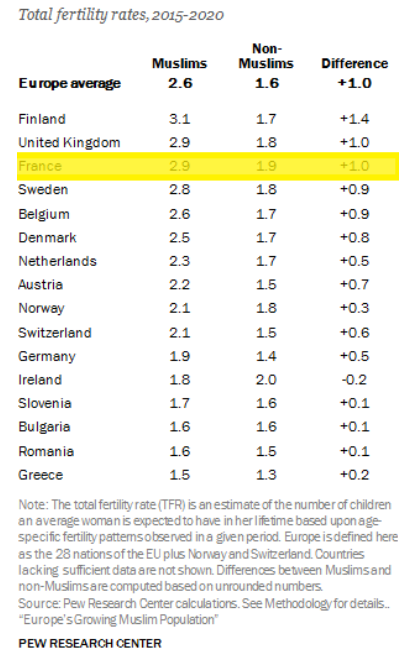
France has ~9mil, Germany has ~6mil, the UK has ~6mil, all comparable. France percentage-wise is also about the same as Bulgaria or Sweden. That doesn't sound like a massive differentiator, with all these other countries hovering around 1.5
I presume this is because the causal factor is women’s independence, specifically financial independence. Perhaps Muslim immigrants in some countries have women with more independence resulting in lower fertility rates, whereas Muslim immigrants in other countries have women with less independence, resulting in higher fertility rates.
People can be nominally Catholic without doing a particularly good job of actually believing in and practicing the tenets of the religion. In fact, this is sort of the rule rather than the exception in much of Europe and North America.
The way to think about this is that people affiliate themselves with tribes for multiple reasons.
One can philosophically not care at all about the beliefs of Catholicism, Judaism, Islam, Hinduism, etc, but for the purposes of interacting with members of their tribe, and signaling to other members of their tribe that they are in that tribe, they might still describe themselves as being “Catholic” (or whatever).
Exactly, and it’s reinforced by the fact that the two main ethnic groups in France (“ethnically French”, and North African Arabs), are distinguished by religion: the former are mostly Catholic, and the latter are virtually all Muslims. So the lines between religion and other markers of identity are blurred.
I don't know if there's a direct line between this and the post ww2 service / office career for all (including women) so that people invested all their thoughts and time in work.
> she declined over the next 250 years to be just another European power.
Why would we want 300 millions inhabitants in France ? That's what we would have with the density of the Netherlands.
Why couldn't France be on top of leisure, urban transports, ecology, natural ecosystems, technology, political innovation, and even military defense, with 70 million inhabitants ?
Worlwide politics are biased, always considering GDP first, instead of a myriad of more relevant indicators.
I did not read the article as "we want 300 million in France", but a study on demographics and the number is just a projection of a data point a few hundred years ago to compare with current number.
I and most people my age in Eastern Europe learned English in the '90s only from American video games and movies instead of French despite us being culturally and geographically closer to France that the US.
If France wanted to export its culture abroad then it should invest in making some kick-ass games and movies, not breed more.
US successfully exported its culture here because it made the best entertainment in the world and we couldn't get enough of it, not because it was a numerous population.
The size of the English-speaking market certainly matters.
Why make a $100 million video game like GTA 5 for 200 million French speakers when you can address the market of 2 billion global English speakers?
(Of course, they do localize it to French after developing it in English. But not everything gets localized and usually it’s targeted primarily at the English market.)
>The size of the English-speaking market certainly matters.
Meh, yo a degree yes, but not always. Korean entertainment had some international smash hits recently that went viral like Parasite, Squid Game, and All Of Us Are Dead, and they were all in Korean not in English. Quality mattes more than language.
I believe that population and entertainment are connected directly. If you have 4x the population you will be swimming downstream when trying to influence others culturally.
Larger domestic market, more money, more eyeballs, more creators.
We increase the human population by another 100x in the never-ending quest to increase GDP, then we run out of resources and die. Dolphins become the most intelligent life on the planet.
That trend is the one thing that may still save us, but don't worry, they'll find a way to prevent that, because a decreasing population also decreases GDP and the stock market, and we can't have that.
The book, "shall the religious inherit the world" is relevant.
I'd be interested what happens when general birthrate declines and a religious group, that massively encourages tons of children, take larger voting percentages.
There are a handful of modern religious and fundamentalist groups that sociologists study for this purpose: Mormons, ultra-orthodox Jews, evangelicals, etc.
The interesting thing about these groups is that they exhibit “carrying limits”: they get to particular community sizes and begin to experience attrition through secularization.
This does not accord with the Israeli experience. The Haredim have grown enough as a proportion that they shifted the Israeli median voter substantially to the right.
I didn’t say attrition overwhelmed the overall growth pattern. Most evidence suggests that it’s a proportion that increases with overall religious population, with compounding or confounding. factors (e.g. increasing or decreasing participation in a broader secular society).
Haredim “get away” with minimizing participation in many ways, which makes their attrition rates lower than comparable religious groups. But that doesn’t last forever; compare the secularization of Jews in Austro-Hungary in the late 19th century.
Modernization drew a lot of people away from traditional religion. But Hasidim and the Amish etc are "post modern". They have developed various cultural features to "immunize" themselves against the temptations of modernity. There is no reason for this to start failing at any particular point, except perhaps when they become too much of an imposition on the rest of society, which pushes back on them.
> The interesting thing about these groups is that they exhibit “carrying limits”: they get to particular community sizes and begin to experience attrition through secularization
I feel like this is true for religious groups in christian-majority countries (or at least traditionally christian countries). I believe that secularization is a christian phenomenon (yes I know it sounds counter-productive), and as such it can only exist in countries with a strong christian tradition.
You will get to see this within the next 50-60 years in Israel. AFAIK the expectation is that Haredi+Israeli Arabs will be 50% of the population by like 2070.
There will be plenty of anti-semitic pro-Israel-for-the-purpose-of-bringing-on-the-apocalypse USA pseudo-evangelicals to support them. (I'm a USA evangelical.)
Even in highly religious Islamic countries, education - especially among women - seems to trump religious indoctrination when it comes to producing children.
It would be interesting to understand how much of that effect is actually education and how much of it is the explicit need to delay reproduction for _any_ socially structured reason.
Because only adults vote, you have to factor in the rate of religious retention for these communities. If 60% of the offspring in a religious community are areligious, the opposite effect will occur.
And this belief/concern presupposes that in democratic societies the political power is held by voters, which I feel is highly reductive even for the most effective democracies
> does religion play a major rile in politics in the rest of the western world?
Hasn’t the growth of Islam in Europe been a large and growing political issue for the past decade?
France in particular has had lot of debates about religious clothing at schools, what kind of criticism of religious ideas is and isn’t acceptable, etc.
From my POV, it looks like religion is a bigger deal in European than American politics. In America, politics are the religion for many and marrying across political lines now carries more opposition than across religious ones, for the majority of people. Things have changed quite a bit since the 80s.
> Hasn’t the growth of Islam in Europe been a large and growing political issue for the past decade?
Probably more like two decades by now :-) The political parties in Europe that pride themselves on anti-Islamism are themselves not religious all. And no one (of any significance) in Western Europe is arguing for a return to Christianity. Some parties advocate “Judeo-Christian values” but the various incarnations of this concept are nebulous at best and mostly completely unrecognizable to Jews and Christians.
At the same time, many Western European countries are now majority atheist or at least majority unaffiliated with organized religion, so, no, religion is not at all a bigger deal in European politics at all.
Those political parties in France talk about “western culture” instead of “Christianity,” but western culture is fundamentally an outgrowth of Christianity. Even if you strip out the supernatural parts, a religion provides all sorts of notions about fairness, justice, forgiveness, family life, the rules and order, etc. People in Europe are still socialized into all that, even if they stop going to church.
This is apparent if you come from a different religious background. I know people who are nominally atheist but you can tell their family is German Protestant a mile away.
No one in France talks about western culture. The main parties which have made Islam a theme are staunchly anti-American.
France has had a strong separation between the state and religion for a century. It’s one of the less religious country in the world and a significant part of the population is still strongly against any kind of religion especially the Catholic Church.
Remind me which country is the one with the hijab ban in schools? Is it america or is it France? And you want to tell me you’re not having a religious conflict over there?
I have issue making sense of your reply to my comment. I don’t see how it’s against anything I said.
As I wrote: "a significant part of the population is still strongly against any kind of religion".
All religious signs are banned in schools not only the hijab. France views religion as strictly a private matter which has no place at all in the public sphere. That’s not a religious conflict just widely incompatible with the American view on the subjects.
You don’t think the French ban on hijab has anything to do with religion? You think it’s just a coincidence and has nothing to do with the fact that Christianity happens not to generally require outwardly visible symbols of membership in a religious community, unlike Islam, Shikhism, Orthodox Judaism, etc.?
Remind me which faith in France add to shoot at civil servants to try to prevent them taking an inventory of the content of their cult places so it could be ceased by the state. I guess you don’t know or you wouldn’t write such idiocies.
But even then, as a French, I would applaud anything going against religions. The faster we get ride of obscurantism the better the world.
Do you truly believe that hijabs and only hijabs (or maybe other Islamic symbols) are banned? Because if so I've got some good news for you - all overt religious symbols are treated equally.
And it’s so convenient that it so happens that Christianity emphasizes one’s personal relationship with god and generally doesn’t require or encourage wearing overt religious symbols.
"Christianity" doesn't emphasize a personal relationship with God; many forms of Protestantism do, but Catholicism does almost the opposite, and French Christians are overwhelmingly Catholic.
Only the ones that integrate well with modern society. There are tv shows that point out the antiquated ways of the Amish such as how they teach their kids and dress their women and their older children's struggles to adjust in broader society, for example.
> Even if you strip out the supernatural parts, a religion provides all sorts of notions about fairness, justice, forgiveness, family life, the rules and order, etc.
Most people would call that a culture.
One were most people do not go to church on Sunday and politicians, even if they’re from a religious background, like Angela Merkel, don’t ever talk about God.
And one that is very different from the one across the Atlantic where “in God we trust” is the national motto and politicians make sure to fluff up their religious credentials.
Sure. But in Europe that culture co-evolved with more than a 1,000 years of Christianity being central to society. The cultural inheritance of Christianity survives whether people go to church or not. The same is true for those Muslim immigrants. They are culturally Muslim. It’s those differences in culture, rooted in religion, that are the source of the conflict, not theology in the abstract.
> One were most people do not go to church on Sunday and politicians, even if they’re from a religious background, like Angela Merkel, don’t ever talk about God.
The German system of offering education in Christianity in public schools would be illegal in America. In Germany abortion is still technically illegal, and is restricted after 12 weeks, whereas in most of America it’s available up to 24 weeks. In Bavaria the government can require Christian crosses to be displayed in all public buildings. In America that would be illegal.
So why doesn’t Merkel talk about Christianity? Is it because Christianity has less influence on government and society in Germany? Or is it because Germany secularism carved out a sphere for Christianity in society, and, unlike in America, nobody is trying to eliminate that sphere?
> And one that is very different from the one across the Atlantic where “in God we trust” is the national motto
What is your point about this? The motto has a long tradition almost as old as the country and it's really not uncommon for European countries to reference God in their national or even unofficial national motto.
> politicians make sure to fluff up their religious credentials.
Like who and how? Most politicians don't do this. Politicians in the US are generally not very religious in my opinion. Ironically, the ones I can think of that are most outspoken about their religion are two Catholics who are at odds with their church leadership over abortion and gay marriage, and Muslims who I somewhat doubt practice Islam. I am struggling to even think of more overtly religious politicians. I just think media reports skew how irreligious politics in the US actually is. I am sure you can find some story about a speech somewhere reference religion or a cross being put up on a state courthouse or something somewhere but I don't think exceptions make the rule and this forgets that even just taking the federal government alone, there are hundreds of politicians who never bring up religion and things are actually much more mundane.
This sounds like a very outdated or caricatured view of the US (where I lived for half of 2022 and also 2012-2015). In those four years I didn't hear the phrase "in God we trust" even one time and the vast majority people I met were either athiest, agnostic or identified as Christian but hadn't been to church in years didn't seem to hold many religious beliefs but had some family background or cultural connection.
If you look, you can definitely religious people but it's not most people or even close. The one large exception to this is the large number of immigrants who were much more likely to be religious and church-going.
Religion is increasingly a political signifier in the USA now. Many MAGA Trump supporters who claim to be Evangelical don't even go to church on any regular basis. "Secular Evangelicalism" is huge in the USA South.
This trend started with William Branham (progenitor of Latter Rain cult, The Message cult, prosperity gospel, healing-campaign revivalism ... leading to the current New Apostolic Reformation) and his mentor Roy E. Davis (Klan leader) in the 1930s. They started a political white supremacist cult with a religious bent. These two spawned a plethora of "heretical" movements still going strong today, a fusion of supremacist, new age ideas from the late 1800s, anti-communist, and evangelical/pentecostal ideas.
(Refer to the "Leaving The Message" YouTube channel. These guys, Branham and Davis, spawned the hydra.)
Eh, as an American I would say it checks out. We really hate each other.
Much of the get-out-the-vote effort on the right consists of reminding their voters why they hate the other side. This naturally pisses off the left. This leads to much angry rhetoric on the left. This rhetoric is nut-picked and put on blast by the media on the right. Etc. The situation isn't symmetric because the left has a lot of issues they're happy to run on: climate change, electoral reforms, education, health care. The right is mostly focused on their hatred of the left -- anti-wokeism, anti-CRT, anti-gender-whatever. The net effect is a lot of hatred.
Religion can play a major role without becoming a point of conflict if everyone agrees. For example, many European countries still have established Christian churches and (possibly opt-out) religious education in schools. If Muslims in Sweden were filing lawsuits to prevent public money from being used to support religious education, or to force Denmark to disestablish the Lutheran Church, I suspect you would see religion becoming a point of contention.
In France, Muslim immigration has made religion a major campaign issue. The French frame it as a matter of secularism versus Islam, but French secularism is better described as a form of Enlightenment-flavored post-Catholicism: https://www.europenowjournal.org/2019/10/02/the-catholic-nes...
If you mean British Prime Ministers, then we have for a long time been allergic to the discussion of religion in British politics; but that goes hand in hand with British reserve. Not a uniformly wonderful thing, to be honest. If the Bishops in the House of Lords were less timid we might get some better debates on moral matters.
Scott Morrison (as a Pentecostal) had religion as a minor part of his platform at least. (I know you probably weren't looking at Australian PM's - but he stands out more so than any of the UK/CA/NZ examples that come to mind. I might be biased though)
I don't see American presidents making religion "a major part of their platform" either. They get some photo ops in church just like British leaders, and they side with their voters on things like abortion, which breaks down roughly along religious lines without being explicitly so.
But a major policy decision directly targeting religion? The closest I can think of in the US is Trump banning immigration from majority-Muslim countries under the pretext of links to terror.
As for the rest of the Western world, you might think of Angela Merkel and Ursula von der Leyen, who explicitly represent the Christian Democratic Union.
And what, if not religion, is driving abortion law in Germany, which has a 12-week limit and restrictions such as waiting periods which were illegal in the US under Roe?
It seems to me like the reason Germany doesn’t have a religiously charged debate on abortion is that no major party is pushing for abortion to 24 weeks or even later like in America.
I'm an atheist and I think that murder is bad despite not believing in the religious sanctity of life. I'd have trouble with full-term abortions of healthy, viable babies.
It doesn't seem unreasonable that other people would have a lower comfort limit, again even without religion.
You don’t think that “comfort limit” has anything to do with Christianity?
If you want to see what atheists do when they’re not bound by the cultural hangover of an abrahamic religion, look at population control efforts in Asia. The Chinese correctly observed that, from a purely utilitarian standpoint, there’s no compelling reason to draw the line at birth.
> from a purely utilitarian standpoint, there’s no compelling reason to draw the line at birth.
Except there is. You want the same protections applied to you, even if you're unconscious or otherwise unable to protest. Pretty much the only broadly supportable position is that killing a viable person is murder and no more or less supportable than them killing you.
How does that factor into the utilitarian calculus? Who cares about you? If a stroke reduces you to the same level of mental functioning as a newborn, why shouldn’t society be able to eliminate you as a burden on them?
The Australian philosopher Peter Singer is a preference utilitarian, and has argued that infanticide should be legal, on preference utilitarian grounds. He argues we have to treat the preferences of all beings equally, but newborns have no concept of what it means to continue to live, so can’t possibly have a preference/wish/desire to go on living. Hence, the only moral obstacle to killing them is the wishes of their parents, therefore (painless) infanticide should be legal with parental consent.
Personally I find his view to be utterly morally abhorrent, but I have to credit him with the courage and consistency of taking utilitarianism to its logical conclusion.
Me. That's why I want to find a simple set of rules that we can both agree to, where you care about me in trade for similar concern and protection.
> If a stroke reduces you to the same level of mental functioning as a newborn
Right, I don't consider that viable without some sort of prognosis of recovery but if we go too far down the line of 'burden to society' it starts to include people who drive too slowly in the passing lane and gets more subjective.
Maybe its harder to see from the inside... As an example I've pulled up the last state of the union address which appears to be a regular and semi-important thing across the pond. God is mentioned 11 times by my count.
That would be considered OOT for a priest over here.
> That would be considered OOT for a priest over here.
Only in the Churches where the religion part is seen with faint embarrassment. Established Churches are the best way to drive religiosity down yet discovered besides banning.
> The closest I can think of in the US is Trump banning immigration from majority-Muslim countries under the pretext of links to terror.
The Trump travel ban is weird in its various iterations. On one hand Trump was on the record during his campaign as wanting to ban Muslims from entering the country entirely, but on the other hand the ban completely omitted the largest predominantly-Muslim countries (Indonesia, Pakistan, Bangladesh). For a sense of scale, those three countries make up about a third of the world's Muslim population. (Add on India and Nigeria and you're looking at half of the global Muslim population.) There was also criticism for omitting places like Saudi Arabia, UAE, and Lebanon (and Egypt, in earlier iterations) which actually had demonstrable ties to 9/11.
But, the original list was mostly consistent with restrictions on the visa waiver program, which is to say the administration probably wanted to start small with the most legally defensible subset before expanding it more broadly. In practice, said restrictions were uniformly blocked by the judicial system.
Ostensibly the first amendment's establishment cause prevents Congress from passing laws that are overly religious, although that doesn't entirely stop them from, say, passing the Defense of Marriage Act or attempting to explicitly opt out churches from COVID restrictions.
These days it's mostly about putting ideologically-aligned judges on the courts and letting them choose which laws to block or precedent to overturn.
>Ostensibly the first amendment's establishment cause prevents Congress from passing laws that are overly religious, although that doesn't entirely stop them from, say, passing the Defense of Marriage Act
No, it does not. The first amendment establishes freedom of religion, and prohibits state-sponsored religion. (The phrase "separation of church and state" is found nowhere in the Constitution.) As the Constitution was originally interpreted, it only applied to the federal government; individual US states had state-sponsored churches into the 19th century.
>or attempting to explicitly opt out churches from COVID restrictions.
This is based on the first amendment's guarantee of freedom of religion. This is why churches, for example, don't pay taxes.
I don’t understand: Are you suggesting that it’s what France is currently experimenting, or did it not fall into your radar that France is currently experiencing this?
If not, I’d be interested if you look at birthrate by religion in France (and please add stats of bullying at school if you find them) and see whether it fits your expected model.
The assumption that religion is something that people stick with is dubious, though. In the absence of coercion people will tend to abandon religion. Look at what's happening to Christianity in the US.
I thought the same, but real life experience shows that in my country (Romania) there is an increase of religion with age, especially for women; in other words, most women start being religious when they age and these days most of the religious traditions are maintained and transmitted by old women. I know many women that were secular in their 20-30, become religious at 50 and are regular churchgoers at 70. My mother used to be a secular feminist engineer 40 years ago, she is none of these today.
As a country we were over 50% secular 30 years ago, the last census tells over 90% declared to be religious (census is wrong, but how wrong?).
Weren't churches a huge factor in deposing Ceausescu and an end to the Soviet influence, as well as the support of populace in hard times before the regime's fall? I'd imagine that would put religion in some favorable light in Romania in particular.
No, top priests were actually collaborationists. The anti-Ceausescu coup d'etat was done by a hard-left, atheist group (public face being Ion Iliescu).
The classic adage: "If you are not a liberal when you are young, you have no heart. If you are not a conservative when you are old, you have no brain" :)
Highly recommend you study history a bit more. If you truly think religion only “sticks” in the presence of coercion… well there’s a lot of history that would be hard to understand.
“Coercion” might be a strong word, but there’s many form of “very strong incentives” applied in most religions. Not being included in the group and face critically harsher survival conditions by not participating in the religion is a form of that for instance.
Starvation and disease of course were primary concerns of prehistoric peoples and can be experienced by nearly all larger life forms.
Poverty really only came into existence once things like 'wealth' were invented. Those things only really came into being once people started to live in larger communities, though not exclusively food based ones. Places like the Chaco Canyon Culture show signs of 'wealth' (and therefore poverty), but only in it's early period, and then only kinda.
War is a bit of a funny one too, as it kinda depends on what we mean by war. Where is the demarcation between family feuds and true warfare?
The Dawn of Everything: A New History of Humanity is a good read into the recent developments into the 198,000 years of human history BC.
Marshall Sahlins studied hunter gatherer bands, and many work less than forty hours a week. Programmers I know can't figure out how to get down to a forty hour a week workweek to survive, but these hunter gather bands in sub-Saharan Africa and the Amazon seem to have figured it out.
foraging only works if there's a sufficiently low population density. the Amazon is so plentiful it even allows these communities to stay relatively fixed, in other climates they had to move around a lot (after relatively exhausting an area)
of course we work a lot more because we want some of that economic surplus to reinvest it back into things that we think will improve our life. a relatively constant life wouldn't require that. also our decision-making and surplus distribution system is very very inefficient compared to a few hundred strong community's.
economically we can afford to build millions individual cars and houses and offices, fully furnish them, and do this again-and-again when old buildings get demolished, old stuff gets dumped into landfills.
we can afford to build tanks and bombs and then do that again and again, and to maintain standing armies.
unfortunately efficiency and longevity is just not a global concern :(
> France appeared to be a stagnant society before the French Revolution. If culture was not changing, then how could it be responsible for such a climactic shift in such an important social outcome?
> Using this genealogical data, I estimate that the decline in fertility took hold in France in the 1760s
1760s don’t look far from the French Revolution to me. Ending a regime that lasted more than a dozen centuries doesn’t happen from a one night cultural shift, and I’d argue a shift starting in the 1960s seems pretty reasonable.
Of course the cultural itself is coming from other factors, but I’m not convinced it can be dismissed so lightly.
In the 1700s France had John Law, wars, famines, and bad kings.
Geopolitically France is an interesting place with one foot in Mediterranean civilization and one foot in Northern Europe, good natural barriers, and a fairly unified culture.
After the religious wars of the Reformation, there was a period of pretty good kings and increasingly strong state, prosperity importing tech from Muslim world via Italy, and liberalization. During this period, Italy, Germany, UK, low countries had their own problems and France was pretty dominant.
Before the French Revolution and the Industrial Revolution, France had 4x the population of Great Britain. After Napoleon's defeat, was never that dominant again. Mediocre kings and Napoleon III, played second fiddle to UK in industrial revolution, political unrest, and Germany unified under Prussia and Rhine industrialists and defeated France in 1870.
Yes. French revolution was partly sparked by high food prices due to poor harvests.
When there is surplus, the population can grow. If production does not increase in step with population growth, there will be shortage. When there is shortage, there is hunger and/or starvation.
The article is very selective: For example there is no mention of the Napoleonic wars. Also there was WW1 - that's another big demographic shift. They built a big defensive line, the Maginot line, because they gathered that they would not have the manpower for another big confrontation, in the style of WW1. However France had a higher birthrate than Germany - in the period after WW2.
Interesting. Also funny that this pioneer of the child-free movement has actually the best fertility rate in Europe currently. Not by much, and still in the negative, but.
it's pretty easy to have children in France, like you have typically 25 + 9 paid days off per year (I personally can't use so many, being a company drone. So I have to take days off to see friends and family)
And it's ok to leave work on time to take care of your children _your coworkers understand that they are more important to you, and they make you happy.
You get a lot of assistance and encouragement from both the local governments and the social fabric. Like there are a lot of clubs to have children to do sports. They're managed by all the parents, by cities, schools,... So finding a hobby for your children isn't so hard.
middle class and low income families can get a lot of subsidies to help them pay for a lot of stuff for their children (including the (in)famous allocations familiales, and 'allocation de rentrée scolaire', that are just spent of flat screens according to right wing ppl)
And you can leave your children at some kindergarten or at they grandparents when you need.
So you can have children without being crazy rich like in the USA, or without being a Rabenmutter like in Germany, and you have time to take care of them.
In the US (and probably the rest of the world) number of children per household is inversely correlated with income[1]. Every time a discussion of birthdates comes up people claim it’s too expensive to have children, but the actual evidence suggests that isn’t a factor.
It's the opportunity cost (how much income are you giving up by having kids), not the absolute income. Also, people at lower incomes have subsidies, so cost of children can be different. For example - in VT, if your income < 150% FPL (federal poverty level), you pay $0 towards child care (versus some people paying > $2000/month in places like NY)
If you calculate opportunity cost, the cost of a child increases dramatically as you go up the income ladder. From tens of thousands of dollars to hundreds (in income missed) or even millions (if you take time off + pay for your kid's schooling in private academies)
Inverse correlation in the US doesn't necessarily mean it's not a factor. You could say for example, that less educated people and therefore statistically poorer have more children because less access to contraception/abortion, and richer people want to be sure they can afford to send their kids to university (all of this needs to be backed by actual figures, I'm just making random claims) so will have fewer kids.
I'd say you need a different kind of measure to say this, at least by comparing people within the same social and economic strata.
> Malthus’s prediction proved false due to two paradigm shifts working together
So this guy makes a prediction, and his entire argument is proven false, but he apparently had an amazing PR firm so to this day his name is used in serious conversation.
In the article he points to the malthusian dynamic operating in England during the same period-more productivity, more babies. Paradigms can be true in some time periods and locations while being false in others.
GDP in "real dollars" is irrelevant here. Any such measurement can't correspond to something meaningful.
Rather "annual calories from agriculture per capita" would reveal much more of the reasons behind this and other upheavals in Europe during the period.
There were climate/weather changes (not well understood or appropriate to research in light of current climate changes) in Europe during 1500-1850, which caused starvation, upheavals, migrations, wars, and so on. They did not affect all areas simultaneously in the same way.
But if the amount of available calories drops below the necessary amount, then famine occurs. How bad this is depends on how much overshoot, and how prepared the population is to find alternatives.
In Irish history, there is the "Great Famine". During the 1800s, maybe 20% of the population of Ireland and the Scandinavian countries emigrated to north america.
The current trend of global warming and increasing harvests started in the later 1800s. Then came mechanised farming, artificial fertilizers, and science.
Blaming the Catholic church specifically for high birth rates is a misstep especially since the author compares to England which has a long and varied history with Protestantism. The argument should be reframed around religiosity in general or he should show data for England that indicates a difference in fertility during the periods of stronger and weaker Catholic influence in England.
He never says the high birth rate is because of the Roman Catholic Church. Every place in Europe was deeply religious and had high birth rates at that time, regardless of the religion. He only blames secularization for the decline in birth rate. It just happens that the rapid secularization happened fastest where the Roman Catholic Church was strongest.
> I argue that the diminished sway of the Catholic Church, nearly 30 years before the French Revolution, was the key driver of the fertility decline
> ...the Catholic Church, threatened by the spread of the Protestant Reformation, took ‘be fruitful and multiply’ seriously and the purpose of marriage became explicitly multiplicative
> The decline of Catholicism, and fertility, in eighteenth-century France turned it from a demographic powerhouse – the China of Europe – to merely a first-rank European power among several
The first and third quotes only say that the birth rate diminished as Catholicism declined, which in a Roman Catholic area means secularization is occurring. Again, this is logically not the same thing as saying that Catholicism itself is the cause of the high birth rate. A birthrate can be high because of one thing and decrease because of something else.
The second quote still doesn’t show that the birth rate was high because of Catholicism. It doesn’t even say what the effect of that position was.
Could catholicism have been the cause of the high birth rate in France before it dropped? Sure. But the article never makes that claim. And it implies otherwise, because it mentions high birth rates around Europe including places that weren’t catholic.
Fully agree with the first part, disagree with the second: women elected to work, they did not needed to work. Single income family was in a way better than dual income family, the world was in a great shape in the '60-'70 when women started to move to paid jobs. Now you have a lot more workers, more leverage to employers and a lot less time spent in the family and less time to have kids when you want to build a career at the same time (and that career is just a regular job in 90% of the cases).
As someone born in the 90s, it does seem like I was born in the "rubble" of a great societal shift from the family to the individual as the atomic unit of evaluating someone's societal stature. Although this shift has had benefits, it made the role of a housewife that of a worthless dependent. I'm not at all lamenting that this is a bad thing. Women should obviously be able to pursue careers the same way as men.
However, it does seem that there is a lag between this change and how society is organized. There are some facts that are hard to ignore:
1. Raising young children without help is a lot of work.
2. Somebody needs to cook. Ordering 3 meals a day from a restaurant is unaffordable for most. There is also a trust/perception issue that "outside food" is not as good as homemade food.
3. If you work a full-time job you can give very little time for anything else.
Some major societal change needs to occur that invalidates one of these three points.
> Today, the political and economic prospects of an empty planet are a worry for many, as more and more countries reach fertility rates below replacement levels.
Yea, it looks like another poltical topic that vary with party. Alarmism about overpopulation is also quite popular.
This is a very thorough piece of research. In particular, if you're saying "in industrialized societies you don't need as many children" you've missed the entire point of the article: he's demonstrating that "having fewer children" began long before industrialization.
> during the Franco-Prussian War of 1870, when France was defeated after a solitary battle against a single opponent.
I was always curious about that war, since "Sedan" is the only battle you ever read about (plus maybe The Commune), so I read a book on it. There were quite a few battles leading up to it. The Germans had better artillery, and their field commanders had more latitude for improvisation.
> In my research, I argue that the diminished sway of the Catholic Church, nearly 30 years before the French Revolution, was the key driver of the fertility decline
That's the problem with demographic transitions colliding with modern political culture.
You're not getting an 50 million European country out of 80 million contry: instead, you will be getting a 80 million African country occupying the same place.
The article claimed that it was a response to the counter reformation based on the decreased likelihood of the opening paragraphs of wills to refer to god. The claim being that people rebelled against the counter reformation.
Poverty does, but not a small decline in standard of living. France isn't a third world country, its just not an imperial power. Seems great to me. On balance, I'd like to live in a modestly successful country without imperial ambitions.
One wonders if that’s stable long-term. The US is a relatively benign hegemon, but that’s just luck. The next one isn’t likely to be very nice at all, going by the standards of history.
So, the demographic transition took place exceptionally early in France, but why? In my research, I argue that the diminished sway of the Catholic Church, nearly 30 years before the French Revolution, was the key driver of the fertility decline.
It more and more seems like "traditional", conservative societies are more successful on aggregate. If they are beneficial to the individuals comprising them, this is a matter of heated debate though. But regardless of that, does the apparent higher fitness of conservative societies (in a global point of view) mean that more "open minded" and "liberated" societies will always be overtaken by the conservative ones ?
Are we cursed to an eternal dance between perceived personal liberty and societal success ?
I'm not sure how you're getting to this enormous generalization. Seems to me that for the past century or so, liberal societies have been the dominant societies on the world stage. Which conservative, traditionalist societies are you thinking of that are more successful or have "higher fitness" than liberal societies?
When I think of an archetypal "conservative, traditional" society, the first countries that spring to mind are Afghanistan and Iran, which I wouldn't call particularly successful countries.
Some like Saudi-Arabia do better by virtue of sitting on an infinite source of money, but even these oil nations have something dysfunctional to them. They tend to be so corrupt and anti-meritocratic that they need foreign companies to perform any non-trivial task, as they can't get anything done themselves and do nothing to foster homegrown talent. They don't produce value beyond what they (or rather, a mix of hired and pseudo-enslaved foreigners) dig up from the ground.
To begin with, the terms "objective" and "relative" are not antonyms. A definition can be both, neither, or either one of the two.
And the terms "progressive" and "conservative" in particular describe attitudes towards the status quo and traditional institutions, which means that whatever exact position a progressive or conservative person takes on an issue will depend on context. By their very definition, the meaning of these words is bound to a particular point in time.
As an example: anyone not on the extreme fringes of the political spectrum will agree with at least the broad strokes of the universal declaration of human rights today, but the adoption of a similar document [1] in revolutionary France was a highly contentious act that directly attacked millennia of institutional power (that is, the divine right of kings).
Conservatives at the time fought this tooth and nail and sought to restore the old institutional power. But most conservatives today would for the most part support this text. In the short term, the Revolution didn't succeed, but on the long term they "won", their ideology largely got adopted and supplanted the old feudal ideology: the Revolutionary ideals are now the status quo in many countries, which many conservatives will defend (support for absolute monarchy is thinly spread even among conservatives today). Nevertheless, it would be deeply absurd to call the French revolutionaries conservatives. In fact, the usage of the terms "left" (supporters of the revolution) and "right" (loyalists to the monarchy) to denote political positions originates from this time.
So yes, at the time, the positions of the French Revolution were progressive, even though the Revolutionaries weren't progressive by today's standards (in particular with regards to women). These terms are fundamentally relative, to try to give them an absolute meaning is simply to not understand them.
So you're arguing that the conservatives at the time failed to conserve their traditional values resulting in their spiritual successors being more liberal. Which in the case of the traditional value of having large families resulted in the demographic decline that is the topic of the article. This seems to clearly support OPs argument that conservative societies will be more successful as long as the values they are conserving are beneficial to the individuals comprising those societies and they succeed in conserving them.
That's not at all what I'm arguing. My comment was purely a response to
> I think we need an objective rather than a relative definition if we're going to do anything other than move goalposts.
I claimed that this is a nonsensical statement for two reasons:
1. You imply that relativity and objectivity are at odds (they aren't -- "I'm taller than my mom" is both a relative and an objective statement).
2. You claim that in order to have a meaningful conversation about conservatism and progressivism, these terms must be defined in an absolute sense. But they are by definition relative. Most of my comment illustrates this point.
I'm not saying that traditional values don't affect fertility rate. My comment was responding to the claim
> It more and more seems like "traditional", conservative societies are more successful on aggregate.
Which is a much more general statement.
I see no evidence for that claim. Evidence that traditional values affect fertility rate does not provide evidence for this claim; for that you need at least some examples of traditional conservative societies outcompeting their more liberal contemporaries in some meaningful way.
"It more and more seems like "traditional", conservative societies are more successful on aggregate."
Weren't pretty much all societies on the planet in the 1700s and 1800s "traditional and conservative"?
Yet most of them weren't particularly successful against the British, who, on aggregate, weren't that much traditional (superficially, yes, but behind the visible old-school clergy and nobility, ruthless modernization continued apace).
Well Germany with it's much more conservative population and petty kings and nobles were able to outgrew liberal Britain and republican France between 1870-1918, and so did Archconservative Russia post-1900 or so.
Of course both fell in WW1 but the period just before it was quite interesting to ponder about.
I am not so sure about your claim that Germany in the indicated period was "much more conservative" than Britain.
The heart of German economic development was in industrial Prussia, resulting in enormous growth of left-wing politics. Bismarck's anti-socialist laws were repealed in 1890 and the SPD since then got the plurality of votes cast in every election to the Reichstag.
Rural Bavaria was much more conservative, yes, but back then it was an economic backwater. Bavaria only started industrializing after 1950.
I don’t want to rain on your parade but Germany had just been unified and was quickly liberalising and Russia was so conservative the communist party would successfully take control of the state in 1917.
I'd love to see some citation for that since most of the ultra conservative countries around the world are failing states both economically and societally.
Everything from Iran, Iraq to European Hungaries to US bible belt states, you can pretty much directly map failure to fringe conservatism.
I'll bite. I have extensive first-hand culture experience (travel, friends, dating) with people from Indonesia, India, and China (PRC). I would broadly categorise all three as very socially conservative -- relative to other G7-level developed, liberal countries.
Economics:
China: Life in a mid- to mega-size city is already pretty good. Yes, it isn't 50K EUR per year, but 10K EUR per year is solid middle class.
India & Indonesia: Life in a mid- to mega-size city is meh-to-OK. In the next decade, urban incomes will very likely double. After, it will be close to China today.
Socially:
All three: Family structures are incredibly deep and supportive -- way deeper than most highly-advanced countries. Part of that comes from strong religious traditions from Taoism/Confucianism, Hinduism, Islam, etc. The lack of social safety net is mostly handled by wider family.
I have much less personal experience with Malaysia, Sri Lanka, Maldives, UAE, Qatar, Kuwait, and Saudi Arabia, but I guess their story is similar to the above three, but higher income.
> Family structures are incredibly deep and supportive -- way deeper than most highly-advanced countries.
As long as you bend the knee to all of your family's beliefs. God forbid you're gay, irreligious or different religion, date someone of another caste/religion, etc...
Well, by the metric of Conservative and high birth rate Afghanistan is currently the most successful country on Earth, as I believe it has the leading population growth rate...
You literally kicked off this thread with the statement
> It more and more seems like "traditional", conservative societies are more successful on aggregate.
Which is a much broader claim than just stating that traditional values increase fertility rate.
After being pressed to provide examples by multiple commenters, and failing to produce even one, you can't just sarcastically pretend that we were talking only about fertility rate all along.
From my equally unfounded gut feel, it's actually balanced societies that are the most successful.
When that balance strongly tilts one way, tension occurs and requires rebalancing for that society to continue to prosper. On society lifetime scale, this usually takes decades which is annoying to a single generation, but a speck in the scheme of things.
In the middle of the 20th century, an extremely conservative, traditionalist society that was technologically modernizing at an extremely high rate but still a feudal empire that was one generation away from pastoralism decided they would attack the most self-declared "liberated" society in the world. The situation proceeded not necessarily to their advantage.
(Despite what the fascists want to think, there's substantial evidence that open societies being more adaptable and innovative is an overwhelming advantage)
This is contradicted by all available evidence: “traditional” societies succeed when they industrialize and liberalize. France was 20% of Europe’s population in 1700, but there is no meaningful sense in which the average French subject was “succeeding” in 1700.
That’s not a great metric of success, as pointed out in TFA: most places with high birth rates have them because environmental pressures demand it. Remove the pressure (excess child mortality), and the social factors that justify high birthrates disappear.
We’re presumably in agreement that imposing excess infant mortality is not a good idea.


It seems far-fetched to use global population as a relative indicator of France's "decline", where the global population exploded after the industrial revolution.