Well that's probably true for what I'll call Wal-Mart libertarians (similar to Wal-Mart wolverines in college football - some will appreciate that), but many people who have actually studied libertarianism would have argued for quite a number of things, ranging from carbon markets to increased government action.
For example, many libertarian flavors hold that the environment is a common good. You can't pollute the river upstream from me because that affects my water and deprives me of property and resources - you'd have to compensate for that. Other libertarians simply believe that markets solve problems better than governments do (hard not to argue with that right now) and that a carbon market that could actually price the damage we do to the environment would be good and also in-line with very principled arguments.
I'd also argue that really libertarians haven't had much of a way of influence in American politics and this is strictly the failure of the USG (Republicans and Democrats) to take action. Also, the vast majority of people can't be bothered to take personal action either - like spending more money to buy local produce or traveling by plane less. Let's not scapegoat a tiny margin of people when we're all very, very wasteful.
> Other libertarians simply believe that markets solve problems better than governments do (hard not to argue with that right now)
Considering that the supply chain problems can be laid squarely at the feet of "markets" assuming that everything would operate in a vacuum like an econ textbook and imploding once external pressure interrupted things, it's very hard to argue with that.
> I'd also argue that really libertarians haven't had much of a way of influence in American politics and this is strictly the failure of the USG (Republicans and Democrats) to take action.
The principal problem with this argument is the "no true Scotsman" attitude of "real libertarians" compared to other "real libertarians". I don't know what "libertarians" are to you, but the obvious answer is that if they haven't had much of an influence in American politics, it's because their policies and stances aren't popular.
Most of the Western world experienced unregulated market dynamics in the robber baron era, and arguably again in the last 10-15 years. We've been there and tried it.
> Considering that the supply chain problems can be laid squarely at the feet of "markets" assuming that everything would operate in a vacuum like an econ textbook and imploding once external pressure interrupted things, it's very hard to argue with that.
I mean yea... we had a gigantic pandemic and people were getting sick. We can also attribute the fact that you have goods and services and a vaccine in your arm to the same markets. Certainly the government helped in some ways but it also completely botched the response to the pandemic.
> The principal problem with this argument is the "no true Scotsman" attitude of "real libertarians" compared to other "real libertarians".
No this isn't that. If you're going to bucket list a bunch of people and say "blah blah blah libertarians think this" then I'm going to point out why that's incorrect and not representative of general libertarian philosophy which is a lot more than what is being discussed in the OP. It's not a fair characterization, and clearing up misconceptions is a fair thing to do.
"Libertarians think X"
"No they actually think X,Y,and Z".
> I don't know what "libertarians" are to you, but the obvious answer is that if they haven't had much of an influence in American politics, it's because their policies and stances aren't popular.
Great so then why are we blaming them again?
If you want to say "they did have an influence" then fine, I'll say that Communists and such have had a big influence too.
> Most of the Western world experienced unregulated market dynamics in the robber baron era, and arguably again in the last 10-15 years. We've been there and tried it.
I'm not sure what your point is here. I guess in response I could say we experienced uncontrolled Communism during the 1940s-1980s and now again with the CCP. We've been there and tried that.
> I mean yea... we had a gigantic pandemic and people were getting sick. We can also attribute the fact that you have goods and services and a vaccine in your arm to the same markets. Certainly the government helped in some ways but it also completely botched the response to the pandemic.
I'm not arguing that the government response to the pandemic was good, though. I'm arguing that the market response to it is and was terrible. Sure, some things remained functional, but having a run on cleaning supplies, hygiene products, electronic components, and others because the markets could not cope with elastic demand isn't a great look.
I understand how we got into this situation (compared to having stocks of unsold product which is eventually written off sitting in a warehouse somewhere). That doesn't excuse it, though. There is little reason other than "satisfy shareholders" that industrial giants should not have been able to keep up on demand for _bleach_.
> No this isn't that. If you're going to bucket list a bunch of people and say "blah blah blah libertarians think this" then I'm going to point out why that's incorrect and not representative of general libertarian philosophy which is a lot more than what is being discussed in the OP. It's not a fair characterization, and clearing up misconceptions is a fair thing to do.
I am not bucket listing a bunch of people and saying "libertarians think this". I am saying that libertarians and what even qualifies as "general libertarian philosophy" is so incredibly fractured and scattershot that even speaking of "libertarians" as some sort of group is an exercise in futility, and not only because people like yourself will leap to the defense of "libertarians" without any clarification at all.
> Great so then why are we blaming them again?
Because it there's ANY unifying theme between "libertarians" and "libertarians", it's "markets handle problems better than governments", which they demonstrably do not.
> If you want to say "they did have an influence" then fine, I'll say that Communists and such have had a big influence too.
And who's arguing for communism here?
> I'm not sure what your point is here. I guess in response I could say we experienced uncontrolled Communism during the 1940s-1980s and now again with the CCP. We've been there and tried that.
Sure, great, amazing. That's a position I'm happy to live with. Quibbling about differences in communist theory isn't relevant, since it actually seems to be popular with Gen Z and Millenials, and maybe they'll get a chance to actually try it through advocacy and electing people who match their beliefs instead of living in some no-man's land of "we don't wanna be part of your system, man, but if we were we'd do it so much better".
> I'm not arguing that the government response to the pandemic was good, though. I'm arguing that the market response to it is and was terrible. Sure, some things remained functional, but having a run on cleaning supplies, hygiene products, electronic components, and others because the markets could not cope with elastic demand isn't a great look.
I guess we just have different expectations. I expected a global pandemic and international shutdowns to affect supply chains. Even with those shut downs we still barely experienced any issues. Like why would you think there wouldn't be a run on something like cleaning supplies when out of nowhere "hey there's a scary (and it was scary) virus and it's infecting people"? The fact that markets immediately started creating new supplies of these products to meet consumer demand is nothing short of a fantastic success. Can't serve alcohol because your bar is closed? Now you're making hand sanitizer. That's the market economy working. I can't believe someone would look at the pandemic and their take away is that our companies failed us. Insanity in my view. It's not even something I can fathom so there isn't really anything to say here other than I couldn't disagree more and it's alien to me to hold that view.
> I am saying that libertarians and what even qualifies as "general libertarian philosophy" is so incredibly fractured and scattershot that even speaking of "libertarians" as some sort of group is an exercise in futility, and not only because people like yourself will leap to the defense of "libertarians" without any clarification at all.
Sure and I was responding to a now flagged OP grouping them together and leaping to the attack for no good reason.
> Because it there's ANY unifying theme between "libertarians" and "libertarians", it's "markets handle problems better than governments",
Ok so we're blaming an ineffectual group that has no relevance on the political stage because we just kind of casually disagree with them? So they're responsible for all the bad stuff?
> which they demonstrably do not.
I mean markets do have issues but as I look around I can't help but think that they are anything but a wild success.
> And who's arguing for communism here?
Nobody, just responding to immature and off the cuff "but the libertarians and markets screwed everything up" with an equally immature "ok fine then I'll just say it's the communists fault". It's like you can have a mature and interesting conversation, or you can lobby garbage posts. I just respond in-kind to what's being presented.
> Sure, great, amazing. That's a position I'm happy to live with. Quibbling about differences in communist theory isn't relevant, since it actually seems to be popular with Gen Z and Millenials, and maybe they'll get a chance to actually try it through advocacy and electing people who match their beliefs instead of living in some no-man's land of "we don't wanna be part of your system, man, but if we were we'd do it so much better".
I'm a millennial and while I'm pretty left leaning there's absolutely no chance I'd ever be advocating for a return to or to implement communist economic systems because we know pretty much for a fact that they just don't work. Not that there aren't good elements we can steal and put into our government to help make sure markets are operating not just efficiently but fairly and people are living nice, healthy lives with a clean environment and opportunities to do interesting things.
There's a reason that countries like Sweden, Singapore, Denmark, Norway, France, and Switzerland (among many others) operate in highly capitalistic and market economies and strictly not communist ones.
> That's how democracy works.
Kind of. Just living together is one option, but if you piss people off eventually they'll just leave. Democracy is about cooperation and coordination, not "now it's my turn".
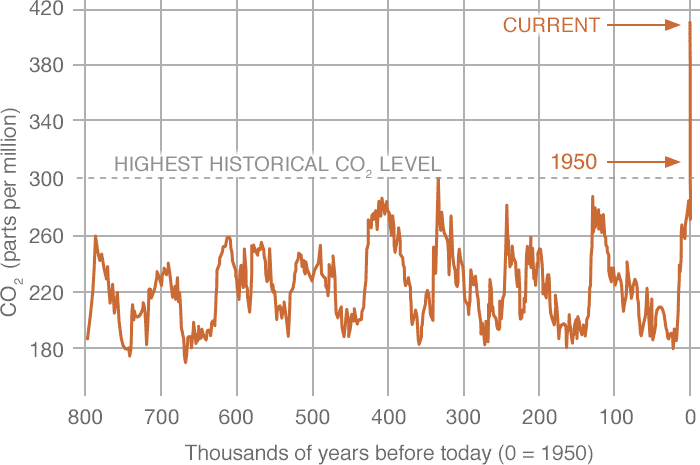
If you can look at this chart and not understand why man-made climate change is a real phenomenon I'm not sure what to say.
FUD about whether some scientist 40 years ago understood this or not is completely irrelevant. You don't need to "trust" anyone to understand this. It's incredibly simple.
Forty years is a fuck load of climate science. You're familiar with how science works right? New data often leads to a better understanding of the world and an increased ability to predict the future.
The year 2000 called and wants its climate denialism trolling points back.
Have you not seen the memo, now it's all about adaptation and impact minimisation now.
If you had the skill to do some algebra and understand soem physics I could link some simple video that would prove that CO2 causes global warming , but I assume you don't believe the data in physics and math books either.
If you think complex systems like the global climate are easy to understand with some algebra and physics, you likely are truly capable of understanding the full picture.
It is easy to understand that putting more CO2 in atmosphere has a heating effect.
So let me split the problem in small parts and see where you get lost
1 do you believe in chemistry,physics and math ?
2 do you believe CO2 is generated when burning stuff?
3 do you believe the CO2 in atmosphere is rising?
4 do you believer that more CO2 means more heat is trapped on the surface?
5 do you believe that the global warming is significant to have an effect?
6 if yes are you maybe just of the opinion that all will be fine and we just need to wait until new tech will solve this ?
I admit that you can just say "sure I believe in science but the numbers/measurements are false because of the "green industry lobby around the entire world that paid all the scientists in all countries and also went in tiem and modified 400+ years records" , then yes, science can't help you.