What a depressing report. It lays out, quite clearly, so many of the things that most of us know, and yet don't know how to confront.
This is predicting that we'll pass the 1.5c threshold by 2030, sooner than I thought.
All of this will lead to predictable outcomes: More war, more humanitarian crises, more mass-migration, strain on food supply, etc...
If only the "perception of insuficient contributions to reduce emissions" was at the highest possible level now, as opposed to after the effects of climate change get much worse.
Agreed, for some reason I thought we'd hit 1.5c by 2100 or something like that. It was very eye opening to see we're already at 1.1c
I'm confident that eventually we'll collectively respond but by that time the expense of the recovery will be huge and the devastation will already be here.
I'm starting to believe more and more in "the great filter"
If you mean non-proportional voting systems, gerrymandering, voter suppression, and lax campaign finance laws, then I think you're right. Many countries have solved those problems, though, so the situation isn't hopeless.
I would hope that any proportional voting system that was introduced would also break the two-party duopoly, but I suppose that's not a guaranteed consequence.
For example, if IRV was more widely adopted, you might still find that only the two big parties ever win seats (although by removing the spoiler effect, third parties become a viable threat which could act to steer the big parties towards more representative policies rather than them relying on the "lesser of two evils" effect).
Conversely, it could be possible to have somewhat popular third parties without a proportional voting system, as is seen in Canada or the UK, but those countries still see the biggest party at the national level always being one of the two main parties.
> All of this will lead to predictable outcomes: More war, more humanitarian crises, more mass-migration, strain on food supply, etc...
How convenient to blame this all on climate change. Makes it easier for the incompetent, corrupt, and downright evil people running our governments, who created these disasters in the first place with their absurd policies, to "save us" with yet more absurd climate policies.
When these policies -- predictably -- make things even worse, they will surely claim we must pass even more onerous, confiscatory, job destroying "climate legislation". When this happens you can re-post your comment after incrementing a few numbers.
Evilness is not a personality trait. Calling people evil only shows a lack of willing to try to understand the reasons behind the actions of those people.
There is no big rich lobby for decarbonization yet. People in governments fight climate change mostly because they believe in it or because they think they can further their career with it (like everyone in top positions).
>How convenient to blame this all on climate change. Makes it easier for the incompetent, corrupt, and downright evil people running our governments, who created these disasters in the first place with their absurd policies, to "save us" with yet more absurd climate policies.
What absurd policies? I suspect you can blame the lack of policies , like those oil extraction where they buts soem excess gas just because it is not profitable enough to use it.
But I am waiting for you to please explain how an anarchy would have done better or some wild capitalist society with no legislation would have done better for the environment.
The environment is fine right now, and according to you, no policies have been in place to "help it". So I guess "anarchy" or "wild capitalism" works just fine.
The economy on the other hand is in total ruins, largely because of policies related to COVID-19, which also had a marginal impact on emissions. Imagine policies that have significant impacts...
I'm sure someone living in some smog ridden hellhole city might disagree, but that's a tiny tiny portion of Earth's livable landmass.
Weather has been temperate, rain plentiful, trees are (were) green and the birds are chirping. It did seem a bit hot last year but this year was much cooler in my area.
Take a walk outside, as far as you can away from human settlement. Nature is stunningly beautiful and does not care at all about human issues.
I live in a village , there are for sure less insects, I rarely see butterflies anymore but don't trust me, there are scientists that put insect traps and measure things, (unless you believe on conspiracies of paid scientists by the green industry then you can continue to deny that things have gone worse.
> The economy on the other hand is in total ruins, largely because of policies related to COVID-19, which also had a marginal impact on emissions.
This is the reddest of herrings. The government's role is to strive for the security and safety of its citizens. "Policies related to COVID-19" are part and parcel of that.
The economy is "in ruins" not because of "policies related to COVID-19", but because in striving for squeezing every last drop of profitability out of things, a "just-in-time" model was adopted for everything under the sun, which fell apart at the first real obstacle.
It's a supply-side crunch from the bottom of the chain on up. Companies which are depleted of capital in order to line people's pockets are unable to jumpstart the process fiscally, and decades of mistreating workers is backfiring as a labor shortage which *should* drive increased wages is leading only to calls for bailouts and government intervention, or _anything_ other than paying market wages.
Don't blame governments for unfettered capitalism being an ouroboros.
I blame governments (and media) for telling business they can't stay open, people that they can't work, and otherwise going out of their way to make basic aspects of life and work as difficult and bureaucratic as possible.
None of this was happening before 2020, despite the constant economic/climate doom porn that this place and others had been engaging in.
It took explicit government action and massive propaganda to get us into the fuckery we are in today. It did not happen because of climate change or "unfettered capitalism".
>It took explicit government action and massive propaganda to get us into the fuckery we are in today. It did not happen because of climate change or "unfettered capitalism".
False, a government could have stopped international travel and fix the problem at it's root, but capitalists wanted to travel aroudn the world and now you pay more. Same shit with anarchist that protested like retards (at least in my country) that they don't want to use masks and today they are waiting 3 hours for a vaccine because the giant number of deaths in their family finally opened their minds.
So you are fucking wrong, greed and anarchy caused lot of death and financial lose, but I am 100% sure your scenario where everyone traveled without masks around the world and in public places is much better feel free to ignore reality too.
You imply that fear is unjustified, unfortunately here in Romania we can see what happens when conspiracy and no restrictions get combined, do a search on your trusted media and compare real numbers (hopefully your trusted media has real numbers)
Fuck dude, me and my son had COVID, I am vaccinated and still got it, he is still a child and I esitated to vaccinate, let me tell you I was afraid for our health and live and who knows how much will it take for our bodies to recover.
The only reason not to fear is if you have no family and maybe you already had COVID and feel invulnerable or if you are a retard ad think COVID is just like the flu.
Seems like you are a person prone to live in fear. Surely once you recover from your illness, you will continue to live in fear because of climate change, and if that was ever somehow resolved to your satisfaction, you'd find something else to provide your fear fix.
Hopefully your young son will grow above and beyond this negative influence, and maybe even teach you that there is more to life than constant anxiety and anger about the End Times. Good luck.
Fear is normal when is justified! Fear prevents people to get killed by avoiding doing dangerous shit. But feel free to be courageous and go visit someone with COVID and then visit your entire family/friends, prove them all that is all fake and there is nothing to be afraid.
Well that's probably true for what I'll call Wal-Mart libertarians (similar to Wal-Mart wolverines in college football - some will appreciate that), but many people who have actually studied libertarianism would have argued for quite a number of things, ranging from carbon markets to increased government action.
For example, many libertarian flavors hold that the environment is a common good. You can't pollute the river upstream from me because that affects my water and deprives me of property and resources - you'd have to compensate for that. Other libertarians simply believe that markets solve problems better than governments do (hard not to argue with that right now) and that a carbon market that could actually price the damage we do to the environment would be good and also in-line with very principled arguments.
I'd also argue that really libertarians haven't had much of a way of influence in American politics and this is strictly the failure of the USG (Republicans and Democrats) to take action. Also, the vast majority of people can't be bothered to take personal action either - like spending more money to buy local produce or traveling by plane less. Let's not scapegoat a tiny margin of people when we're all very, very wasteful.
> Other libertarians simply believe that markets solve problems better than governments do (hard not to argue with that right now)
Considering that the supply chain problems can be laid squarely at the feet of "markets" assuming that everything would operate in a vacuum like an econ textbook and imploding once external pressure interrupted things, it's very hard to argue with that.
> I'd also argue that really libertarians haven't had much of a way of influence in American politics and this is strictly the failure of the USG (Republicans and Democrats) to take action.
The principal problem with this argument is the "no true Scotsman" attitude of "real libertarians" compared to other "real libertarians". I don't know what "libertarians" are to you, but the obvious answer is that if they haven't had much of an influence in American politics, it's because their policies and stances aren't popular.
Most of the Western world experienced unregulated market dynamics in the robber baron era, and arguably again in the last 10-15 years. We've been there and tried it.
> Considering that the supply chain problems can be laid squarely at the feet of "markets" assuming that everything would operate in a vacuum like an econ textbook and imploding once external pressure interrupted things, it's very hard to argue with that.
I mean yea... we had a gigantic pandemic and people were getting sick. We can also attribute the fact that you have goods and services and a vaccine in your arm to the same markets. Certainly the government helped in some ways but it also completely botched the response to the pandemic.
> The principal problem with this argument is the "no true Scotsman" attitude of "real libertarians" compared to other "real libertarians".
No this isn't that. If you're going to bucket list a bunch of people and say "blah blah blah libertarians think this" then I'm going to point out why that's incorrect and not representative of general libertarian philosophy which is a lot more than what is being discussed in the OP. It's not a fair characterization, and clearing up misconceptions is a fair thing to do.
"Libertarians think X"
"No they actually think X,Y,and Z".
> I don't know what "libertarians" are to you, but the obvious answer is that if they haven't had much of an influence in American politics, it's because their policies and stances aren't popular.
Great so then why are we blaming them again?
If you want to say "they did have an influence" then fine, I'll say that Communists and such have had a big influence too.
> Most of the Western world experienced unregulated market dynamics in the robber baron era, and arguably again in the last 10-15 years. We've been there and tried it.
I'm not sure what your point is here. I guess in response I could say we experienced uncontrolled Communism during the 1940s-1980s and now again with the CCP. We've been there and tried that.
> I mean yea... we had a gigantic pandemic and people were getting sick. We can also attribute the fact that you have goods and services and a vaccine in your arm to the same markets. Certainly the government helped in some ways but it also completely botched the response to the pandemic.
I'm not arguing that the government response to the pandemic was good, though. I'm arguing that the market response to it is and was terrible. Sure, some things remained functional, but having a run on cleaning supplies, hygiene products, electronic components, and others because the markets could not cope with elastic demand isn't a great look.
I understand how we got into this situation (compared to having stocks of unsold product which is eventually written off sitting in a warehouse somewhere). That doesn't excuse it, though. There is little reason other than "satisfy shareholders" that industrial giants should not have been able to keep up on demand for _bleach_.
> No this isn't that. If you're going to bucket list a bunch of people and say "blah blah blah libertarians think this" then I'm going to point out why that's incorrect and not representative of general libertarian philosophy which is a lot more than what is being discussed in the OP. It's not a fair characterization, and clearing up misconceptions is a fair thing to do.
I am not bucket listing a bunch of people and saying "libertarians think this". I am saying that libertarians and what even qualifies as "general libertarian philosophy" is so incredibly fractured and scattershot that even speaking of "libertarians" as some sort of group is an exercise in futility, and not only because people like yourself will leap to the defense of "libertarians" without any clarification at all.
> Great so then why are we blaming them again?
Because it there's ANY unifying theme between "libertarians" and "libertarians", it's "markets handle problems better than governments", which they demonstrably do not.
> If you want to say "they did have an influence" then fine, I'll say that Communists and such have had a big influence too.
And who's arguing for communism here?
> I'm not sure what your point is here. I guess in response I could say we experienced uncontrolled Communism during the 1940s-1980s and now again with the CCP. We've been there and tried that.
Sure, great, amazing. That's a position I'm happy to live with. Quibbling about differences in communist theory isn't relevant, since it actually seems to be popular with Gen Z and Millenials, and maybe they'll get a chance to actually try it through advocacy and electing people who match their beliefs instead of living in some no-man's land of "we don't wanna be part of your system, man, but if we were we'd do it so much better".
> I'm not arguing that the government response to the pandemic was good, though. I'm arguing that the market response to it is and was terrible. Sure, some things remained functional, but having a run on cleaning supplies, hygiene products, electronic components, and others because the markets could not cope with elastic demand isn't a great look.
I guess we just have different expectations. I expected a global pandemic and international shutdowns to affect supply chains. Even with those shut downs we still barely experienced any issues. Like why would you think there wouldn't be a run on something like cleaning supplies when out of nowhere "hey there's a scary (and it was scary) virus and it's infecting people"? The fact that markets immediately started creating new supplies of these products to meet consumer demand is nothing short of a fantastic success. Can't serve alcohol because your bar is closed? Now you're making hand sanitizer. That's the market economy working. I can't believe someone would look at the pandemic and their take away is that our companies failed us. Insanity in my view. It's not even something I can fathom so there isn't really anything to say here other than I couldn't disagree more and it's alien to me to hold that view.
> I am saying that libertarians and what even qualifies as "general libertarian philosophy" is so incredibly fractured and scattershot that even speaking of "libertarians" as some sort of group is an exercise in futility, and not only because people like yourself will leap to the defense of "libertarians" without any clarification at all.
Sure and I was responding to a now flagged OP grouping them together and leaping to the attack for no good reason.
> Because it there's ANY unifying theme between "libertarians" and "libertarians", it's "markets handle problems better than governments",
Ok so we're blaming an ineffectual group that has no relevance on the political stage because we just kind of casually disagree with them? So they're responsible for all the bad stuff?
> which they demonstrably do not.
I mean markets do have issues but as I look around I can't help but think that they are anything but a wild success.
> And who's arguing for communism here?
Nobody, just responding to immature and off the cuff "but the libertarians and markets screwed everything up" with an equally immature "ok fine then I'll just say it's the communists fault". It's like you can have a mature and interesting conversation, or you can lobby garbage posts. I just respond in-kind to what's being presented.
> Sure, great, amazing. That's a position I'm happy to live with. Quibbling about differences in communist theory isn't relevant, since it actually seems to be popular with Gen Z and Millenials, and maybe they'll get a chance to actually try it through advocacy and electing people who match their beliefs instead of living in some no-man's land of "we don't wanna be part of your system, man, but if we were we'd do it so much better".
I'm a millennial and while I'm pretty left leaning there's absolutely no chance I'd ever be advocating for a return to or to implement communist economic systems because we know pretty much for a fact that they just don't work. Not that there aren't good elements we can steal and put into our government to help make sure markets are operating not just efficiently but fairly and people are living nice, healthy lives with a clean environment and opportunities to do interesting things.
There's a reason that countries like Sweden, Singapore, Denmark, Norway, France, and Switzerland (among many others) operate in highly capitalistic and market economies and strictly not communist ones.
> That's how democracy works.
Kind of. Just living together is one option, but if you piss people off eventually they'll just leave. Democracy is about cooperation and coordination, not "now it's my turn".
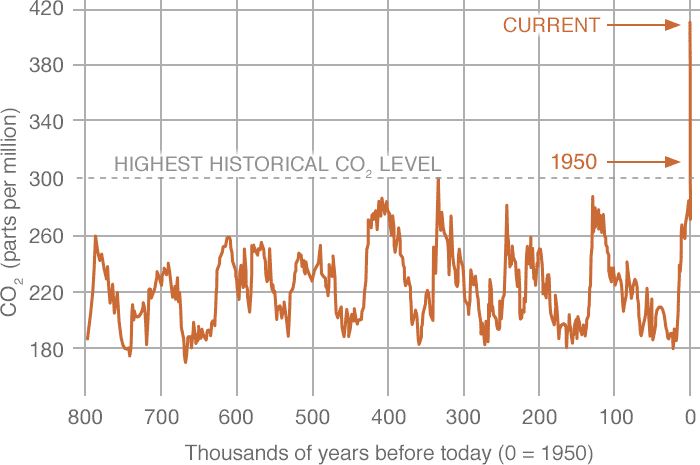
If you can look at this chart and not understand why man-made climate change is a real phenomenon I'm not sure what to say.
FUD about whether some scientist 40 years ago understood this or not is completely irrelevant. You don't need to "trust" anyone to understand this. It's incredibly simple.
Forty years is a fuck load of climate science. You're familiar with how science works right? New data often leads to a better understanding of the world and an increased ability to predict the future.
The year 2000 called and wants its climate denialism trolling points back.
Have you not seen the memo, now it's all about adaptation and impact minimisation now.
If you had the skill to do some algebra and understand soem physics I could link some simple video that would prove that CO2 causes global warming , but I assume you don't believe the data in physics and math books either.
If you think complex systems like the global climate are easy to understand with some algebra and physics, you likely are truly capable of understanding the full picture.
It is easy to understand that putting more CO2 in atmosphere has a heating effect.
So let me split the problem in small parts and see where you get lost
1 do you believe in chemistry,physics and math ?
2 do you believe CO2 is generated when burning stuff?
3 do you believe the CO2 in atmosphere is rising?
4 do you believer that more CO2 means more heat is trapped on the surface?
5 do you believe that the global warming is significant to have an effect?
6 if yes are you maybe just of the opinion that all will be fine and we just need to wait until new tech will solve this ?
I admit that you can just say "sure I believe in science but the numbers/measurements are false because of the "green industry lobby around the entire world that paid all the scientists in all countries and also went in tiem and modified 400+ years records" , then yes, science can't help you.
China is the world's biggest C02 producer and has declared it has no more concessions to make. Yet the world is content to watch America fall further into debt & inflation as climate-focused regulations impact logistics, energy & manufacturing. In sum, the US is destabilizing, risking social disorder, for a goal its competitors will not meet.
For example, US coal supplies are the lowest they've been in decades at a time when domestic energy demands are requiring about 16% more coal than last year. Similarly, the backlog at California ports is largely due to environmental regulations enacted by the CA legislature (truck emissions primarily).
Putting this imbalance in national security context... Resources China & Russia could be allocating to climate change are instead directed to offensive hypersonic weapons, nuclear launch capabilities & forward deployed bases. The US is scrambling to match these investments and innovations in a more expensive labor/procurement environment & while facing all manner of distractions declared national priorities, yet having nothing to do with real security.
China has the largest population and an over proportional industrial production, which is responsible for the high CO2 emissions. And it invests more in decreasing CO2 emissions than the US
Consumption is the root cause of the emissions. As long as the demand for goods continues, they have to be produced somewhere. Whether the factories are in US or in China is completely irrelevant.
Furthermore, China is now a world leader in both solar and nuclear, and they're actively exporting this technology. The reality of the situation is that investing into clean energy is very profitable, and China has now secured its position as the world leader. When other countries start getting their act together, they'll be buying this technology from China.
The United States exports coal. The San Pedro Bay backup has nothing to do with California emission standards; it has to do with COVID causing labor shortages. Seattle is having the same problem with the same cause.
1. No, chassis don't pollute. The CARB standards on trucks have nothing to do with the ports. Moreover, those CARB standards are adopted by 16 other states including Oregon and Washington. So your uncited 40% get nowhere near a West Coast port.
2. No, that wasn't 'CA regs'. It was a local Long Beach ordinance. And it was for empties. And it was never a problem before but as soon as Flexport CEO Ryan Petersen brought it up, Long Beach issued an emergency variance [1], like within a day. FWIW, the Seattle Fire Department has the same two high regulation.
3. There are a lot more points in the supply chain that use labor and that have been affected by COVID than container crane operators. It is a complex issue [4].
We're well past the point of stopping climate change. The world as we know it today is over. What we're fighting for now, is the extent to which that world as we know it will be destroyed.
We seem to be incapable of making wise long term decisions that require sacrifice. I am resigned to simply enjoying what we have, while we have it.
The problem with any such "climate disaster" is that humans are incapable of conceptualizing the impact of such slow change.
We can't even solve our water use, and that is going to cause collapse much sooner than the climate. And it's obvious looking at the oncoming water crisis that those who are most vulnerable will also be least protected, while the supply chains oligarchical institutions are going to be nearly completely enshrined.
We are 20 years away, as a conglomeration of democracies, from even being capable of appropriately addressing climate change.
For years there have been dire warnings about sea level rise, we have seen the same warnings in the last week in the Dutch press again. Apparently lots of ice is melting for years/decades.
Yet, there is no acceleration in the sea level rise on our shores, which has been at a relatively stable ~2mm a year for over a century. Furthermore, sea level has risen since we exitted the ice age, our North Sea used to be land.
> The problem with any such "climate disaster" is that humans are incapable of conceptualizing the impact of such slow change.
It certainly seems that way (that "that humans are incapable of conceptualizing...", or even better, replace "conceptualizing" with "<X>"), but is it really so? It is surely presently "true" (if one ignores potentiality), but is it absolutely true (across time and all potential paths)?
As a thought experiment, if you rewind 30 or so years, would this statement be an absolute Truth: "Humans are incapable of writing an operating system that <does all the things that Linux does in 2021>"?
Also consider: if Richard Stallman, Andrew Tanenbaum, and Linus Torvalds had done something other than what they actually did[1], where would we (and the internet, etc) be today?
If you then consider humanity's ~paralysis on climate change (or any of our many problems) in this context, doesn't the situation we find ourselves in (on all fronts) seem more than a little absurd? I mean, if we never actually try[2] to achieve something, should we be surprised when we do not achieve it?
"Linus Torvalds has stated on separate occasions that if the GNU kernel or 386BSD had been available at the time (1991), he probably would not have created Linux."
[2] Is it not reasonably true that not only do we not try, but we don't even think about trying, or think about desiring (a plausible pre-requisite for trying) to try to think about trying , etc etc etc, recurse to infinity.
We're also trying various rapid responses to a slow change, and they're all so subject to political corruption that it's widely assumed that politics is the sole source of the problem.
Try telling someone in Ohio there's a water shortage; they'll glance at the river and look at you like you have three heads.
I'd like to maximize my chances of retiring in a place without major climate issues in 20 years. Where would I find a model that would show me a place on Earth that's likely to be "fine" (or conversely, places where one would definitely not want to find themselves living in)?
For example, this report mentions that by 2040 developing countries are going to struggle, so I wouldn't want to retire to a developing country.
Is the weather in Alaska likely to get much warmer and reach temperatures like in California?
There's going to be strain on energy and food systems, so I suppose I'll have to be able to grow my own food, at least to some degree, so I would need a decent garden and good weather to grow the food. And so on..
Are there any resources to start planning this semi-seriously, without getting sucked into a whole "world is going to end" doomsday prepper narrative with guns, zombies and bunkers?
I imagine that land and housing prices in such future areas is only going to increase, so it would be nice to get ahead of the curve.
I can't offer you any sources, only what I've gathered and synthesized over the last decade or so:
Climate change is going to make the world hotter and drier, on average. You want a place that is currently cool and rainy. Think oceanic climate zones. In the US, that's the PNW, and the Alaskan Peninsula. The only problem is that area is extremely vulnerable to major earthquakes. Second best bet is the Great lakes region. Third is northern new england, around lake champlain.
When it comes to other areas of the world, NZ comes up a lot. There's also places like Portugal, Galacia (sp), Ireland, the UK, and much of the Scandi countries.
The drier on average can be somewhat misleading: with each +1℃ the atmosphere can hold approximately 7% more water on average. That's why increased incidents of wet bulb extremes are going to kill a lot of people. There will also be wildly shifting weather patterns. Those weather patterns may make some regions more prone to drought, but the key terms to expect with climate change would be hotter, more unpredictable, and greater extremes. Droughts may be drier, floods more devastating, etc. Just look at Siberia hitting 100℉ much faster than the average temperature increase elsewhere: the temperature is rising much more quickly at the northern pole compared to elsewhere in the world. This will be an uneven regional process with innumerable factors involved. It's not unprecedented for complete local climate shifts to occur in the geologic record, and much more likely given the rate of change we're causing. One we know of, for instance, is that the Amazon forest is likely to switch to being a desert given its current deforestation trajectory. Something might e.g. shift an ocean current that turns a dependent climate pattern much colder, or drier, or hotter. We can predict some of these, but the further we push the global climate out of the only patterns we have good, modern historical data on, the weirder it might become. So in other words, even if you move to a cool and rainy place now, the climate dice we're playing with may not favor you. I think it's important for people to grok this because adaptation in a +3℃ world or greater is going to involve much more than just moving further north or south. It's going to affect everyone everywhere. You might escape some heat up north only to face the landscape deforming and belching up more methane in the atmosphere than any human has breathed, and perhaps some defrosting pandemic pathogens that haven't infected a new body for thousands of years. The known unknowns are likely bad, and the unknown unknowns are myriad.
I get what you're saying. This is all true, but even so you will almost certainly be better off in an oceanic climate than elsewhere, even if there are unprecedented effects such as the BC heat wave.
"fine within this timeframe", that may be shorter than you think. As things become more extreme new weather patterns seem to be emerging, with some weather events that surprised meteorologists. Think that a Canadian town at lat 50 got almost 50ºC this very year.
In the long term, if nothing meaningful is done, no place would be safe, at least in the open. But I don't know how things will develop in the 20 years timeframe, both in the climate and in the human side.
Its never too late to start learning how to grow food! I imagine if you try to learn when things are melting down, it won't be a fruitful experience. You only need a bit of space to grow as a beginner. I've started a hydroponic system for about 50$ on my porch, which is about 5x10 feet. There is a massive pool of resources to learn from on YouTube or from books.


This is predicting that we'll pass the 1.5c threshold by 2030, sooner than I thought.
All of this will lead to predictable outcomes: More war, more humanitarian crises, more mass-migration, strain on food supply, etc...
If only the "perception of insuficient contributions to reduce emissions" was at the highest possible level now, as opposed to after the effects of climate change get much worse.