CDE makes me happy because it's really old but still actively maintained. Sometimes, when I get fed up with GNOME's latest "innovations" and Firefox's endless UI changes and all the other endless churn and change of modern software, I pull the latest version of CDE and start a session and just... relax. Because this is the same CDE that was around in the 90s, this is the same CDE that ran on Solaris and AIX, that outlived HPUX, that has had zero UX changes in living memory, that you could come back to after a 20-year break and find everything where right you left it. And I think that stability is beautiful.
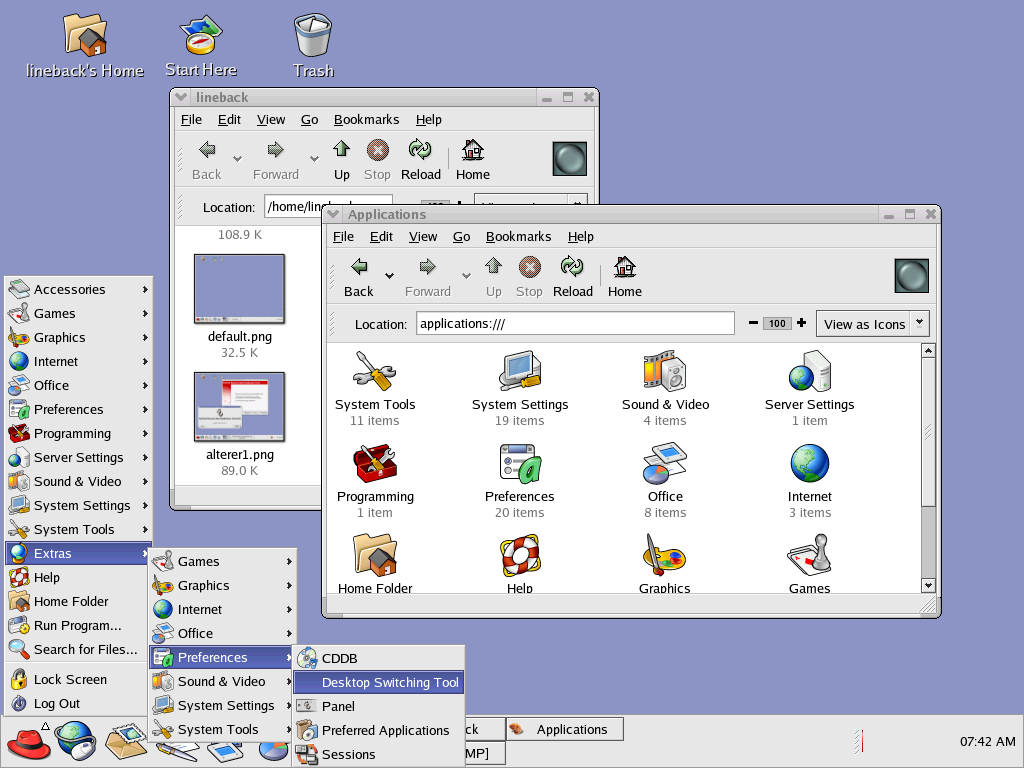
I could be slightly opinionated but Gnome v2.2 which shipped with Redhat 7/8/9 in early 2000s was my peak desktop experience. Bluecurve icons felt beautiful, polished & didn't look all flat for e.g. [1]. In comparison, Gnome3 was a mess, buggy and somehow cinnamon/xfce desktop couldn't ever bring back the elegance & sheer joy of early RedHat GUI
I never used Gnome (any version) all that much, but I have similar feelings about Windows 2000.
Recently I used Windows 10 a bit because I had to test some things, and it's just so ... chaotic. Buttons everywhere, the "flat" UI just makes it hard to see what's what (including what's a button), and "clippy" is basically built-in now given how often the thing whines and nags notifications at you.
The Windows 2000 UI wasn't perfect, but it clear, simple, and mostly "just worked".
I can agree. Windows 2000 had 15,000+ minor-major issues pre-release. But Microsoft really did churn to get that right quickly before release & over service packs, minor updates etc. Especially with the flak Windows ME got & antitrust lawsuit of late 2000-mid 2001, they were really serious about the existential crisis of their cash cow. Windows was the major money pull before Office & further, cloud services took over.
Incidentally, 2000 & ME had a lot of design elements common to them. There was a cleaner zen startup of the famous 4-color artsy shaded logo, an improved taskbar, various desktop shading, inbuilt media slideshow & full screen view option, folder & icon themes, which didn't look pixelated. Windows media player 7 was odd shaped but funky & having some visualization out of the box. There was winamp & Sonic media players too. All running in usually 32MB RAM & 20 GB hard drive. Screensavers & desktop themes could be installed (thanks Chip/Digit magazine!) & they were actually fun.
The teenage me installed a Virtua Girl desktop application out of curiosity & imagine the horrors when it starts stripping on your desktop, "standing" or "sitting" on the taskbar. Good grief! Those were days of having a single PC for the whole family.
Good ol' times.
Edit: The worst offender was Windows 8 with Metro UI. I couldn't figure out how to safely shutdown. The reveal of the power menu to the screen border was purely accidental
The situation was also comparable with KDE, I think KDE 3 was for me peak Desktop. It seems afterwards the race to be like Windows started. Although the common Linux Desktop environments were far more advanced than Windows especially in terms of flexibility - just the application variety was lacking behind.
The design aesthetics of early Gnome, KDE was influenced a lot by classic Macintosh, BeOS and the likes. And classic UI was genuinely great. It never came in the way - agreed that you had to live with the defaults most times - but the defaults were mostly good.
The race to customizability & the notion that GUI correspondence could win some Win9x fence sitters over, really did it big time for future Gnome & KDE.
KDE 1.x in particular took a lot of influence from CDE. See the design of the taskbar, virtual desktop switcher, window decorations, scrollbars etc in these screenshots: https://en.wikipedia.org/wiki/K_Desktop_Environment_1
This is the reason behind all the s/C/K naming substitutions within the KDE ecosystem!
I wasn't a big GNOME fan even back then, but I agree, the Bluecurve theme was lovely, and it looked great on both GNOME and KDE. KDE has never looked so good, before or since.
It honestly escapes me, given the vast variety of themes out there, that since
the RHL era, no other distro has ever coordinated its themes across all desktops that way. It's a great way to bring a coordinated look across a distro.
Ubuntu's old Ambiance and Radiance themes have been a strong part of its brand for a decade or more. Why doesn't Kubuntu, Xubuntu, Lubuntu etc. modify and adopt the standard Ubuntu house style?
Fedora's GNOME themes are also great looking, even speaking as someone who doesn't like the desktop itself. Jakub Steiner is a design genius:
https://jimmac.eu/
The other Fedora respins should adopt the look, and present a unified brand.
Same for openSUSE, Debian and any other distro with multiple desktops.
"Hewlett-Packard, IBM, SunSoft, and USL announced CDE in June 1993 as a joint development within the Common Open Software Environment (COSE) initiative."
Configuring FVWM it's far more difficult, and I did it
several times under lots of Linux and BSD's.
CWM was a breeze. I just added a bigger border,
keyndings for tags,
xclock and xload at the bottom-right corner, stacked up.
Done.
I have it w/ OpenBSD under a netbook, it
flies.
I say this because I use FVWM for old unstable software from the 90's,
some computational nature (mandelbrot, chaotic systems, attractors)
code. The examples from the book crash CWM.
And setting up FVWM it's difficult for different screens...
They are still using SourceForge. Click through the link at the top of this page to see for yourself. Or google "cde desktop" and follow those links to SourceForge. Or check the CDE Wikipedia page and notice how they link to SourceForge.
Huh, you're right; Wikipedia puts the EOL of the current version at 2025-12-31. I wonder if they changed that or I misremembered; I was quite sure that I'd read of it being EOLed years ago. (Or perhaps I did read an EOL notice but they were announcing it on Enterprise timelines, i.e. "heads up that it'll finally die in a mere 8 more years"...)
Um. So I think you're the first person I've ever encountered who had anything good to say for it. I never had the pleasure, so I'm working from second-hand accounts; what was good about it?
The GIMP was first released on Motif widgets, and it crashed often.
The frustration with Motif's code quality led to the GIMP ToolKit (GTK).
I doubt Motif would have survived, even if it was open. There were obvious problems.
"A GUI toolkit called GTK (at the time known as the GIMP ToolKit) was developed to facilitate the development of GIMP. The development of the GIMP ToolKit has been attributed to Peter Mattis becoming disenchanted with the Motif toolkit GIMP originally used. Motif was used up until GIMP 0.60."
> The GIMP was first released on Motif widgets, and it crashed often.
Do you mean Lesstif ? Motif was not available for free.
The fact that it crashed can be attributed to code quality. There were a lot of professional programs that used Motif.
I can recall getting statically linked binaries of an early Motif-based GIMP on the "bonus CD" that came with a '90s Linux book which included Slackware on CD.
The early GTK-based versions did look more modern, in a 90s way, but the benefit was that you could actually build them reasonably. Lesstif was sort of late to the party, and then was soon superceded when real Motif got opened.
KDE (the Kool Desktop Environment) was created as a free clone of CDE[0]. Then GNOME was started because of licensing problems with Qt[1].
Had CDE and Motif been open sourced under a suitable license then, it is likely there would have been a single major desktop environment effort, at least in the start.
I never used CDE for real, but during my training at a large-ish IT company, I worked on one project where our dev/testing machine was a small Sun server running Solaris 8 (it's been a while). After a while, out of whimsy more than anything else, I installed an X server on my windows desktop and logged into the Sparc server via XDMCP, so I got to experience the full grey-and-pink glory for a short while.
Anyway, what I meant to say is that it makes my nostalgia bone tickle that people are maintaining this software today. I might even try it out sometime.
Anybody know if it works on Wayland? (Just kidding! Or am I?)
The apps probably run in XWayland just like any other X apps. The Window Manager is trickier but apparently XWayland has recently gained support for running a full X root so technically yes:
Huh, that’s pretty neat! But it’s not able to manage Wayland applications, is it? From the Phoronix post it almost sounds like this might be really intended run X desktops on systems that can only use Wayland?
I absolutely LOVED running Solaris 7/8 on my x86 desktop in college. It made me feel like a "real" developer. Even though CDE and MWM look positively ancient by today's standards, there's still something about them I really enjoy. They feel like you're using your computer to do "work". I enjoy macOS, but there's still something about that UI that makes it feel like a consumer-focused machine (understandably). The old-school Linux/Unix UI always felt like it was designed for someone different. I wish that there were a more modern version of CDE/MWM that maintained that same feel. Updated rendering, compositing, etc. but without the sad attempts at "commercial appeal" like I see in Gnome and KDE now.
This is awesome, although CDE was a tiny bit before my time, when I was gifted an AlphaServer 2100A that ran OpenVMS I remember being amazed at CDE and then discovering it had OpenDX (The visualisation software) which was loaded with a bunch of scientific computing examples. I was totally hooked. It was a transformational moment in my young life!
It could be just me, but I find that UI repulsive. I had the (mis)fortune of using CDE back in 2005 on the job working on Solaris, and I remember not liking it back then either; slow and ugly is what I remember; but I didn't mind since I didn't have any strong opinions about the UI/UX back then. I was coming from a Windows development environment, so perhaps that's why CDE felt like a severe downgrade in experience.
Yeah, it always kind of sucked. The UNIX-HATERS handbook famously described Motif as looking like the Moscow Airport. But, unlike GNOME and Firefox, it doesn't suck more every release.
"X will not run in these 4-bit overlay planes. This is because I’m using
Motif, which is so sophisticated it forces you to put a 1” thick border
around each window in case your mouse is so worthless you can’t hit
anything you aim at, so you need widgets designed from the same
style manual as the runway at Moscow International Airport."
Yeah, Xaw and I think SunView would run on a 1-bit-deep display (though my recent quest for 1-bit-deep OpenWindows/OpenLook/XView screenshots came up empty), but Motif is less accommodating in that sense. And, although it looks worse than SunView, it's not nearly as shitty as Xaw.
A big contributing factor to Motif's profligate palette consumption was the bevels to make it look "3-D". I think Motif was actually an inept attempt to ape the aesthetically uninspired Microsoft Windows, which was not very popular yet, but which (relevant here) ran fine on 4-bit displays. Because that's what the VGA gave you in 640×480, and a Windows that limited you to 320×200 or 640×200 on a VGA would have been a non-starter.
Open Look had a bit of a 3-D look to it, but for example (original) Macintosh and Genera were pretty flat-looking. GEOS was mostly pretty flat with the exception of the occasional drop shadow. The Newton GUI (postdating Motif) managed to get quite a bit of visual depth out of grayscale, but I don't think the Newton ever had a 1-bit display. The Palm Pilot (postdating Newton) looked like a less ugly GEOS.
In theory there are all kinds of depth cues you can use to get a comprehensively 3-D look on a 1-bit display, but I haven't found a GUI toolkit that managed it.
PC/GEOS had plenty of bevels, if you ran it on a 16 colour display. I recall contemporary reviews said "it looks a lot like Motif" and it really does aside from the distinctive typography and the things they invented from whole cloth
Yeah, compared to Windows of the time it did come up short in Power User readiness. Especially by 2005. Using it in 2005 seems kinda late in the commercial game for CDE.
Are you comparing it to KDE as in the software ecosystem / integrated desktop experience? "Fully" would be a misleading way to compare in that case. Someone who lives in a given text editor and needs a pleasant, lightweight host with extra nostalgia built in may really love it. Grass-is-greener holistic consumer software critics probably not so much.
Depends on your standards. CDE is, by modern standards, rather feature poor; if you actually use any significant slice of KDE's features it'll feel very limiting. On the other hand, IME it's also far less buggy than KDE (possibly for similar reasons; your features can't break if they don't exist), and it's stable both in the sense that I don't think I've ever seen it crash, and in the sense that I don't think I've ever seen it noticeably change. Mixed bag, YMMV.
CDE was not great, but KDE still has major UI issues. Was just trying out the new Konsole and the "show menu" setting changes places between the menu <--> context menu, depending on whether it is set or not.
Also the silly new toolbar buttons were really hard to find to hide, shouldn't have to google change such basic stuff. Tells me that no one is paying attention to these details. Iterm2, while not perfect is much better at these things. As is gnome/mate-terminal etc.
There is no font compositor; text is less attractive.
There was no HTML browser for the early life of CDE. NCSA Mosaic was the first, followed by Netscape for the RISC platforms.
The native terminal app, DTTerm, is not tabbed. Such a GUI element would take another decade.
Don't turn on the server components unless they are patched (ToolTalk specifically).
There is a GUI-enabled Korn shell, dtksh, but it is an ancient version the last time I looked. Most scripting sourced library code from a book by Pendergrast (of which I found a copy after lots of searches). I used dtksh for basic operations dialogs in the past, so I had some interest.
I used CDE professionally back in the day (a long time ago). It was very good in its day, but I use KDE now, and I would never go back to using CDE. If I were feeling nostalgic for old software I'd rather go play with TOPS-20.
I am pretty sure there is support for changing the size of fonts and titlebars, but I’m not sure if there’s anything else that scales. I doubt anything scales _well_.
The thing is, CDE predates high DPI monitors by so long that most of the beefy workstations running it were considered particularly high resolution at something like 1152x864 or 1280x1024. Widget scaling really was the last thing on anybody’s mind…