Low-background lead is also sought after in shipwrecks [0]. With lead it isn't contamination from nuclear tests that's the issue, but natural radioactivity that needs hundreds of years to decay.
It's always confused me how mined lead somehow has more radioactivity. Shouldn't the lead in the ground also have decayed over time?
Also, it makes me wonder why someone enterprising hasn't stockpiled a few tons of the stuff somewhere to let it become low background lead for the future. You'd think that some government or another would be able to drop a million dollars on putting a lead stockpile somewhere safe for the future.
> It's always confused me how mined lead somehow has more radioactivity. Shouldn't the lead in the ground also have decayed over time?
Looking into this a bit, it seems that the radiation in refined lead isn't coming from the lead ore, but from the other materials used in the smelting process. Old lead would have had time for all those things to decay.
So this is all kinds of wrong. When you make steel, you typically use 99+% pure oxygen - modern mills do air separation and reject nitrogen and argon (which makes steel brittle when it's dissolved in) and basically anything they can reasonably separate out but oxygen.
But furthermore, it's not radioactive oxygen isotopes that get into the steel in the first place - they're scant to non-existent in nature, since all three common isotopes of oxygen are stable and most of the rest decay in seconds. It's other radioactive isotopes in the air from the bomb tests.
99+% isn't 100%, and it turns out those tiny fractions of a percent of junk contain the isotopes that are the real problem, namely Cobalt-60 created by the nuclear tests. Carbon-14 isn't nearly as big of a problem, since its decay mode is just beta and can be designed around, but the gamma decay from Cobalt-60 contamination is much harder to deal with.
Furthermore, because of Cobalt's position on the periodic table and the desire to have a small amount of cobalt in steel anyways to give it better working properties, it's not something that's easily filtered out, even in processes that reform steel like vacuum remelting which exist to make mechanically harder and better quality steel by slow melting and recrystalization. Once the Cobalt's in there, it's in there - you just have to wait for it to decay.
As it turns out, we're in luck, most of the fallout from those bomb tests has passed through numerous half-lives and is much less of a problem today than it was in the 1980s and 1990s when the low background stuff became such a hot commodity. So it doesn't really matter as much that we're running out. Furthermore, oxygen separation technologies and cryogenic liquid handling have improved, so we can do an even better job keeping contamination out. If someone wanted to set up a low background mill, they probably could do it today with commodity molecular sieves and centrifugation of the oxygen rejecting all but the light fraction...
> How is the cobalt getting mixed with the stuff mined from the ground?
So the term "fallout" is actually a pretty piece of propaganda. While a lot of it did or does indeed "fall out", there's still a lot of radioactivity in the air and on the surface from those nuclear tests in the form of fine particulate. It's in the fine dust all around you as 100nm and smaller particles, dancing around the air through Brownian motion. It's all over everything all of the time. It's in the water and the ocean. Nanograms here and there and everywhere. Not enough to really cause you health problems anymore, but plenty enough to increase the background radiation of the entire surface of the planet by a tiny amount.
How it gets into the steel is through the actual blasting of oxygen into the steel - hundreds of cubic meters of oxygen are used per ton of steel made, concentrating those tiny particulates into the steel they're going into and dissolving them throughout the melt, which is precisely why using ultrapure oxygen and vacuum processes could be used to make lower background steel today... if there was high enough demand to justify the absurd cost of that kind of handling. Fortunately though, there was plenty of steel made before the 1940s, and the demand is not all that high since it's usually used as a shielding material and not as large structural elements. As long as they don't remelt it, or do so in a high vacuum reformer, the metal can retain its low background nature.
Intermediate-lived gamma-emitting isotopes (cobalt-60, strontium-90, cesium-137, and so on) are the particular problem children of nuclear fallout in steel making. The cesium and strontium are largely removed by the same processes as steel is made in the first place - they're simply reactive enough to bond with the silicon and carbon and aluminum impurities being removed and will happily exclude the majority of themselves as part of the slag. So while they do contribute to the background, they're not the main problem. Cobalt, on the other hand, is right next to iron on the periodic table and its happy to stay stuck to the iron, even through rounds of recrystallization. Once the cobalt is in the steel, it's in there until it decays away to nickel over the next century or so. (This is also why it's much less of a problem now than it was even 20 years ago; the halflife of cobalt-60 is about 5 years, which means much of it from the nuclear testing is already gone - most of what remains is from nuclear reactor releases and neutron activation products.)
The more sensitive your instrument needs to be, the more radioactive contamination wrecks your instrument, which is already why physics experiments have to go to extreme lengths to keep everything clean of dust and debris, and are often located underground or underwater to avoid exposure to cosmic rays and atmospheric muons decaying. But the even higher sensitivity experiments like dark matter searches and measurements of cosmic background radiation have little choice but to reach for low background steels and lead as shielding material.
I'm not sure about this; smelting lead is generally done in a blast furnace, fed with coke. Burning that coke is going to produce a ton of CO2. Is that good enough because the carbon in the coke is all very old? (Searching for information relating to C-14 and coal lead me to a bunch of wacko new earth creationist websites claiming that carbon dating indicates coal is young...)
Also, maybe this isn't really a concern, but "high temperature and pure oxygen" makes me think "metal fire."
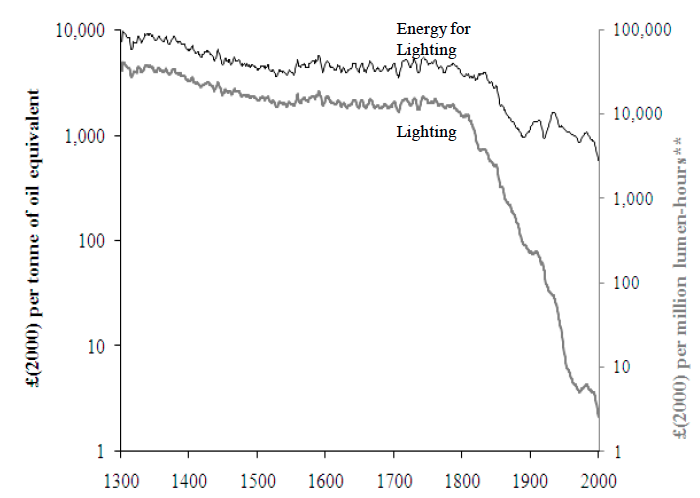
Money-oriented thinking is a road to economic misunderstanding. The economy is about stuff. In practice one often measures all the stuff using money, yes, because what else would one use? but as a proxy measure for its value; it's never actually about the money itself.
(stuff = "final goods and services" to be technical)
Energy witch can be food, oil, gas, the energy transformator is a human (or his brain) a maschine or a animal, and the exchange between energie to the endresult is often money. So money/exchangemedium has just the worth both partys agreed on.
Now you are measuring electricity instead of the light you read by, and fuel instead of the vacation trip you take with it. You have worsened the problem I refer to.
Surely energy input is the right metric. If I use a gallon of gas to power a life-saving ambulance or if I burn it just for fun, those two actions should have the same importance.
Energy IS electricity, and to create a Lightbulp you NEED energy, it's exactly the same.
For your vacation trip you NEED energie in form of food an fuel, the vehicle you travel in, is made by food and fuel...exacly the same.
If the transport company accept your fuel (or workforce witch again is fulled by energie (your food)) as payment, you exchanged energie to energie, probably they dont and thats why you use a exchangemedium called money.
EDIT: You dont have to messure anything, if you need light exchange energy to light, travel exchange fuel to distance, working body food to (body)-energy. To make stuff you calculate the sum of the energie needed for, and thats the price of the product, sure exeptions like apple exists ;)
the fundamentally inescapable problem is your approach measures an input instead of output, and thus makes technology improvements look like an economic crash
Yes. The demand for low background steel and lead is in the few dozen tons per year max, not millions of tons per year. Salvaging it is probably at least an order of magnitude cheaper than making new low background steel once you realize the amount of hassle involved. Furthermore, it's fairly easily recycled if you're not launching it into space (which is a common use case for the stuff, since building space probes to study the cosmic background is all the rage these days).
As others said, simply separating the CO2 away would mostly get rid of the problem - all non-stable isotopes of Oxygen have a max half life of 122 seconds, but, for the record, isotopic separation is easy when there is a very large difference in atomic weight.
In Uranium's case it's difficult because it's 235/238 = 1.28% (actually way worse - Uranium hexafluoride is used, which adds 114 units, bringing the ratio down to 0.86%)
In Oxygen's case the ratio would be at least 6.6% (15 vs 16).
Most importantly in Uranium you are interested in the tiny amount of U235, while in Oxygen you'd be interested in the huge bulk of O16, O17, O18, which are the stable isotopes. O16 alone is 99.762% of all Oxygen, and you can afford to lose half in your centrifuge if it spares you a few cycles, it's not exactly hard to come by.
What would be the timeframe over which one would make a profit? Our global financial system is based on the 30 year U.S. Treasury bond. There are no economic incentives to plan beyond 30 years.
Probably a few hundred years, so yeah, it wouldn't be worth it to the people doing it at all within their lifetime. That's why I was suspecting a far-sighted government or such with enough money to squirrel it away for future use.
The US sorta has a few things like that already--the oil reserve & the stockpile of helium, though I understand the latter is winding down still. Given the importance of those materials to science, I would think that there might be some scientifically-motivated project to protect our access to such things.
I don't know of any good sources. But my understanding is that there are very few "Methuselah bonds" by which it is meant instruments that have lifespans of 50 years or more. So anybody with a profit motive has no advantage for putting money into something that would have a longer term focus. This explains to me why, for example, banks are still loaning money for buildings on Miami Beach. I would love to understand the dynamics better. It seems to me that only governments can be planning for longer terms. China, maybe?
Forget filters. It would have to be done in a vacuum and you would need to centrifuge the required gasses/carbon. It is possible in small batches, but the sunken ships do exist ready to harvest. Maybe in the future the market will come.
I had some low radiation lead for a while, makes for an interesting curio. As I recall its providence was re-melted musket balls from a shipwreck in the Bahamas.
Yeah :-) I kept it as a neat hack for selling lead from a shipwreck that had paid for itself by selling off the gold and other bits, and the salvage operator was effectively eeking out a few more bucks from the geek crowd :-).


[0] https://www.theatlantic.com/science/archive/2019/10/search-d...