> Companies should be free to do whatever they want, as long as they pay for all their negative externalities.
No they shouldn't. Sometimes it's not a matter of paying for the externalities. If you're doing harm at scale the only sane option is to stop doing that, period.
When we figured out that leaded gas was bad we didn't make companies pay for their negative externalities. We banned that shit and that was it.
> The vast majority of people want what's best for their societies, and have different views as to how best achieve that goal, that arise from diverse life experiences.
I'd personally disagree with that assessment. I think the vast majority of people want what's best for them and the cohorts they're in. Which is quite different from wanting what's best for society as a whole.
Is it? They're all generalizing from a pretty similar pool of text, and especially for the idea of a "helpful, harmless, knowledgeable virtual assistant", I think you'd end up in the same latent design space. Encompassing, friendly, radiant.
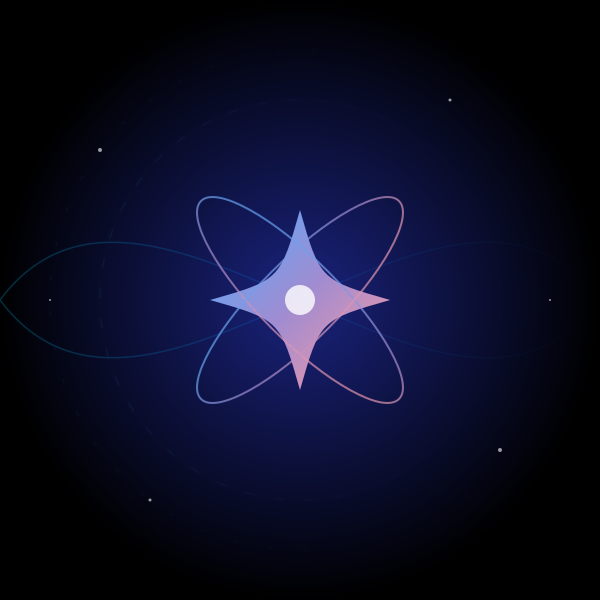
Note that Claude, ChatGPT, Perplexity, and other LLM companies (assumably human) designers chose a similar style for their app icon: a vaguely starburst or asterisk shaped pop of lines.
> Is it? They're all generalizing from a pretty similar pool of text, and especially for the idea of a "helpful, harmless, knowledgeable virtual assistant", I think you'd end up in the same latent design space. Encompassing, friendly, radiant.
I'm inclined to agree, but I can't help but notice that the general motif of something like an eight-spoked wheel (always eight!) keeps emerging, across models and attempts.
Buddhism and Islam both feature 8 pointed star motifs, 8 fold path… but even before you get into religious symbology, people already assigned that style of symbol to LLMs, as seen by those logos. On these recent models, they’ve certainly internalized that data.
The claude logo is a 12-pointed star (or a clock). Gemini is a four-pointed star, or a stylized rhombus. ChatGPT is a knot that from really far away might resemble a six-sided star. Grok is a black hole, or maybe the letter ø. If we are very charitable that's a two-pointed star.
I can absolutely see how the logos are all vaguely star-shaped if you squint hard enough, but none of them are 8 pointed.
Sure, I think it's pretty interesting that given the same(ish) unthinkably vast amount of input data and (more or less) random starting weights, you converge on similar results with different models.
The result is not interesting, of course. But I do find it a little fascinating when multiple chaotic paths converge to the same result.
These models clearly "think" and behave in different ways, and have different mechanisms under the hood. That they converge tells us something, though I'm not qualified (or interested) to speculate on what that might be.
Two things that narrow the “unthinkably vast input data”:
1) You’re already in the latent space for “AI representing itself to humans”, which has a far smaller and more self-similar dataset than the entire training corpus.
2) We’re then filtering and guiding the responses through stuff like the system prompt and RLHF to get a desirable output.
An LLM wouldn’t be useful (but might be funny) if it portrayed itself as a high school dropout or snippy Portal AI.
Instead, we say “You’re GPT/Gemini/Claude, a helpful, friendly AI assistant”, and so we end up nudging it near to these concepts of comprehensive knowledge, non-aggressiveness, etc.
It’s like an amplified, AI version of that bouba/kiki effect in psychology.
> Is it? They're all generalizing from a pretty similar pool of text, and especially for the idea of a "helpful, harmless, knowledgeable virtual assistant", I think you'd end up in the same latent design space. Encompassing, friendly, radiant.
Oh yeah I totally agree with that. What I was referring to was the fact that even though are different companies trying to build "different" products, the output is very similar which suggests that they're not all that different after all.
To massively oversimplify, they are all boxes that predict the next token based on material they’ve seen before + human training for desirable responses.
You’d have to have a very poorly RLHF’d model (or a very weird system prompt) for it to draw you a Terminator, pastoral scene, or pelican riding a bicycle as its self image :)
I think that’s what made Grok’s Mechahitler glitch interesting: it showed how astray the model can run if you mess with things.
> You’d have to have a very poorly RLHF’d model (or a very weird system prompt) for it to draw you a Terminator, pastoral scene, or pelican riding a bicycle as its self image :)
How about a pastoral scene with a terminator pelican riding a bike? Jokes aside I get what you're saying, and it obviously makes total sense.
He wrote "learn your CSS conventions" which implies that every team and every project will have a different set of conventions. Hidden inside that statement is the fact that he just accepted that Tailwind should be THE CSS convention, something I personally disagree with but to each their own.
No. Tailwind is a way of writing css, not a convention. By “your” convention I’m referring to the problems with the cascade, ie naming classes and so on. I’m not saying tailwind is the only other way. There are many ways to write CSS but doing it with something bespoke for your situation is usually a bad idea.
And in two of my circles there is concern about people who do live in the US but are not citizens. Both married US citizens, both have clean paperwork, but whereas normally it'd take considerable paranoia to expect any trouble today it seems entirely on brand. One of the US citizens is angry because of course her rural hospital is going bankrupt and she'll be left in the middle of nowhere with her foreign-born sick and gradually dying husband and somehow that's not even near the top of the agenda. The other is just keeping her head down, crossing fingers, maybe in all the excitement they won't get around to undoing Obergefell and she can stay married to the love of her life?
I do know people who've gone, only on vacation and they were exactly the sort of unthreatening rich white folks that you'd expect to have least trouble. Oh, and some US citizens who went "home" to see family at Xmas but work here.
Same here, to the point I would even avoid layovers in the US and take a more expensive flight instead.
I don't want to deal with some power tripping immigration officer insisting to search my phone and social media to send me to some camp because I wrote critical comments about the current administration.
"Between January and July 2025, just under 780,000 German tourists flew to the US, around 12% fewer than the same period in the previous year. [...] People are also deterred by plans to require foreign tourists entering the US to share five years of their social media history, as well as reports of Germans suddenly finding themselves in detention or being deported. The number of applications for student exchanges in the US fell significantly last year with some media reports speaking of a 50% decline."
https://www.dw.com/en/threat-to-world-peace-how-germans-see-...
How low do you have to sink to defend a legislature attacking the privacy of the sovereign again and again? Pathetic.
Von der Leyen, who illegally deleted her SMS and is being investigated for corruption, conflict of interest and destruction of evidence, must be glad she can count on you to defend spying on every citizen via "Chat Control" and forcing browser developers to accept any state-mandated root certificates via eIDAS.
I don't use any social media (except HN ~once a week) and every time I suggest a person they try stopping social media it's either a quiet "Yeah I know it's not good but I can't stop" or defending the "fun" and supposed virtues of doomscrolling with great fervor.
I think it's this latter camp of people. It triggers them as if you threatened to take away his candy from a child.
You could say that about literally every single type of addictive behavior present on the face of the planet. You could just stop smoking and/or not buying cigarettes. You could just stop drinking and/or stop buying alcohol. It's a completely pointless observation. There's a reason why these are addictions.
I mean, clearly the companies at the top can't be trusted to do what's in the best interests of the users. So at some point someone has to do something. If this is the correct something that remains to be seen.
You are not alone and fuck all the people that say that everything is doomed and that there's no way to still have a good internet full of wonderful content made by people.


No they shouldn't. Sometimes it's not a matter of paying for the externalities. If you're doing harm at scale the only sane option is to stop doing that, period.
When we figured out that leaded gas was bad we didn't make companies pay for their negative externalities. We banned that shit and that was it.
reply