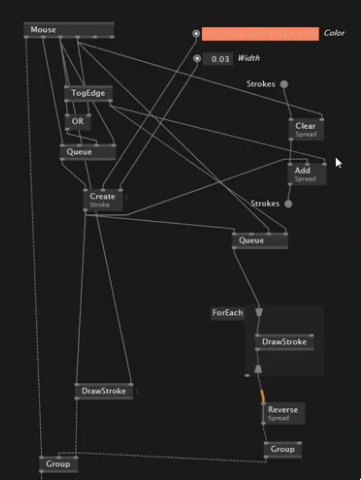
We're using it as render engine for our visual live-programming environment vvvv: https://visualprogramming.net It allows you to play around with the engine fairly quickly. To get an impression, here is an intro tutorial that shows it in action: https://youtu.be/Cs60A_pSIy0 Also check out FUSE which builds on top of vvvv/stride: https://www.thefuselab.io/
Helo HN, joreg here, one of the devvvvs team of 5. We've just released a preview of the new 3d engine VL.Stride for vvvv. It is based on the open-source .NET engine http://stride3d.net
It is free for non-commercial use without any restrictions, no registration required. Windows only for now.
Looking forward to your feedback and please let us know if this is something that could be useful for you!
Agreed! Many of those claims completely disregard the research in visual programming that has happened in the past 30 years. Specifically the idea that it is about visual vs. textual seems utterly outdated now that more and more modern development environments find ways to combine the best of both worlds.
If anyone finds the time to update these claims, please consider our vvvv in your research:
- A visual programming environment for the .NET ecosystem
- Compiles to C# using Roslyn
- Can use code from any .NET library as visual code blocks
- Its language VL augments dataflow with features from OOP and functional programming, supports generics and easy multithreading
- Useful since 2002: https://vimeo.com/371511910
I'll preface by saying that vvvv looks impressive and certainly seems like one of the more polished options in this space. We have a type of visual programming as part of an internal configuration tool, and I will definitely look into vvvv for how things can be done differently.
I'm not saying it's bad – it might just be a question of habit whether or not graph edges are better than named identifiers in text, but it is hard to build away, even with best in class tooling.
It has it's advantages and disadvantages, same goes for text-programming though: Sometimes in text you store results in badly named variables because it is hard to make up a meaningful term for each step of a computation. In those cases visual code shines because instead of forcing you to come up with a name it allows you to directly connect things with the added benefit of visualizing dataflow, thus structuring your code. If you have an algorithm though where each interim result can be clearly named, then text code shines.
So roughly we argue that the more high-level your code is, the better it works visually, the more low-level it is, the better it is expressed in text. And it is therefore about a combination of both worlds.
We don't have this yet in vvvv gamma (but have it in vvvv beta) that you can at any point write text-code if you prefer and wrap this in a node for further use in your visual graph.
And thanks for pointing this out! I'm afraid the core of vvvv is not open source but all of its libraries are. And also please follow us on mastodon: https://mastodon.xyz/@vvvv
helo HN, joreg here, one of the devvvvs team of 5. After more than 7 years in R&D we've just released the second major release of our visual live programming environment vvvv, titled "vvvv gamma". It uses our language "VL" which compiles to C# using roslyn and it is using state hot-reload to allow you to modify programs while they are running.
It combines metaphors known from dataflow programming with others known from OOP and functional programming, but all visual. Still if you want you can extend it with C# code easily and even consume any .NET library from nuget.org directly without the need to write any plugin-wrapper boilerplate code.
From previous HN discussions we know you all have an opinion on visual programming, so please try vvvv, we hope it to be different to what you expect. It is free for non-commercial use without any restrictions, no registration required. Windows only for now.
Looking forward to your feedback and please let us know if this is something that could be useful for you!
Indeed very interesting and Processing comes to mind when I looked at the visuals, however it is very interesting that integrates with .net. Can F# be used to drive workflows/scenes? Any plug-ins for this?
I will definitely play with it. Looks fantastic, thanks for sharing with us
There are no plugins: You can simply use any .NET dll by referencing it, just as you would in C# or F#. Here is a repo with very simple demos of how to write your own nodes using C# or F#: https://github.com/vvvv/vl.demolib
Hey this looks really sharp. It seems a bit like Processing but for .NET, is that a fair characterization and if not how would you say your project differs? (Asking only for elucidation and to maybe stimulate some discussion on the thread, definitely not commenting in the vein of “Processing does this so what’s the point”. A world with more tools like this is a good thing.)
Right, the most obvious difference is that vvvv is visual. Then comes the "live-programming" aspect which means that in vvvv you don't "edit-compile-fixcompiletimeerror-compile-run" but you always only run and modify the running program. Compilation happens in the background. If there is a compile-time error, vvvv points that out for you, but keeps running. runtime-errors also don't necessarily completely stop the program.
So while in the end you can certainly achieve the same things with vvvv and processing, the way you do things is very different.
We now have 2 products "vvvv beta" the one that we first released in 2002 and "vvvv gamma" which we just released. We need to get them both represented on vvvv.org eventually but for a start it was easier to create a second page.
Vereniging Van Vlaamse Vliegfissers aka Association of Flemish Fly Fishermen
I wasn't expecting that. ;)
But seriously, I was expecting some kind of explanation or corporate mission statement, but all I got was visual repetitions of VVVV showing up in various designs and architecture.
> Commercial use includes funded academic research
That’s a very strange definition of commercial projects. Research works by getting external funding precisely because the results aren’t usually directly commercialisable.
Right, like this it reads weird. It does not mean that we consider funded academic research "commercial", but that in addition to what is commonly understood as "commercial use of vvvv" we're also asking teams that have funding to support our research by buying licenses. We wanted to make a distinction to education, where vvvv is completely free to use.