> The researchers directly observed atoms known as “bosons,” which bunched up in a quantum phenomenon to form a wave. They also captured atoms known as “fermions”...
Is this a typo? Aren't those subatomic particles? This is repeated throughout the article.
...the linked paper[1] is titled: Measuring Pair Correlations in Bose and Fermi Gases via Atom-Resolved Microscopy
Maybe i am missing something? i can only read the abstract.
"...Still in the early stages, Loops is not yet open sourced, nor has it completed its integration with ActivityPub, the protocol that powers Mastodon, Pixelfed, PeerTube, and other federated apps..."
Hey, PeerTube is already open source, and works on ActivityPub:
This. It's by @dansup@mastodon.social and if there's anything I've learned about this internaut it's that dansup delivers. The work on Pixelfed is exceptional.
So, to be fair reddit is supposedly the 18th most visited site online today[1]. Given it's popularity i guess i won't hold it against Stross. I, myself, find it somewhat hard to avoid, though i try my best and steer clear. IMHO it's just one of those toxic places, though there are many of them online. Actually it's becoming sort of like a fundamental law of tech and online these days(that everything is toxic - actually there are a few places that aren't so bad, but they are becoming harder to find). Someone should write a book. Funny, i didn't realize Ohanian had a connection to HN[2].
> As for me, I still believe in open source, and even in the commercial potential of open source. It requires creativity and a clever business acumen to identify and exploit market opportunities within this collaborative framework. To win in open source you must embrace this collaboration and embrace the fact that you will share the commercial market for the software with other entities. If you’re up to that challenge, then let’s keep beating the open source drum together. If not, these new movements(source-available software) may be a home for you – but know that a lot of hard work still lies ahead of you in that path.
This article feels more like a critique of the new "source-available" trend in tech whereby existing OSS projects sell out and try to retroactively re-license themselves to be more closed-source friendly. I've been sort of aware of this phenomenon since there was a small upset when Muse Group bought Audacity, though it appears it is still GPL[1].
Anybody know a quick work around for the middle mouse button? Actually it appears I'm also having trouble with the keyboard too. My wireless keyboard+trackpad worked fine yesterday on raspberry pi os. It is refreshing though to see an OS that is lightweight and quick to install, and doesn't give you any surprise errors after you got it all updated about stuff like the web-browser is not supported on your model B+(even if i wasn't able to connect to internet and actually test functionality). Life is tough! I'm spending too much time trying to figure out all this random half-baked tech.
I forgot this is an 8 day old thread. There is actually a lot about RISC OS that i think seems favorable over running raspi os, just based on the tiny amount of testing i did on both, and getting neither to work for my use-case: I like how small RISC OS is, and it seems to have a better method for adjusting scan to my TV - raspi os doesn't seem to have a way to adjust that. It does seem like there could be some improvements at making it more plug and play; or maybe it is my wireless keyboards fault. i'll have to report back after i get that figured out.
Ok, well final story is, i rummaged around and found some wired keyboards and mice. It was a little frustrating, but i finally found a pair that seemed to function. I'm still not sure what the point of 3 mouse buttons is; it seems like right and left click do the same thing(that is with the mouse i was able to actually get working - maybe RISC OS doesn't like any of my mice). Also the [FN]+Q,W,E,arrows trick didn't work on my keyboard that actually had a Function key. I guess i could have rummaged more(and maybe i will), but my hardware generally works fine with the linux distros I have used(mostly MX). It seems like some more work could be done here. Also, my wifi dongle seems to be recognized but incorrectly as a usb-ethernet interface, so i have an IP, but no internet, and i can't find a way to change that. riscosopen.org says sign-ups are disabled i need to email the webmaster; maybe i will; i am interested in trying out RISC OS, but it doesn't give me much confidence with my experience so far. ...it looks like MX still publishes a 32bit version, so i guess i can try and run that on my old Model 2 B+? ...but i bet it's going to have the same problem with no web-browser. So i guess all my 32bit stuff is bricks now? on a side note, i noticed some degradation in the desktop experience with the latest version of MX on my old laptop(it is a Thinkpad T510 with an intel i5). It is still functional, but i can feel the walls closing in.
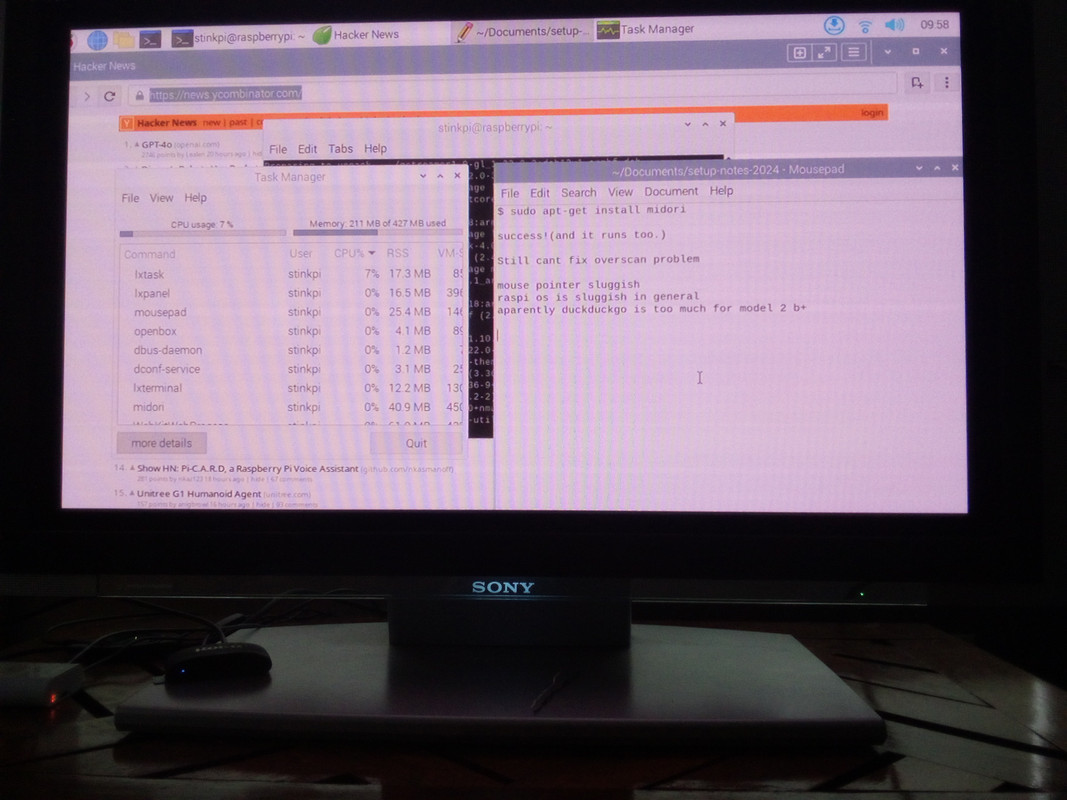
Well, i went back to raspi os, and installed midori, and it successfully ran and loaded a page, though it quickly became apparent that raspbery pi os on an old model 2 B+ was not going to work(cpu + mem overload = slow) I have a vague memory of connecting a screen+keyboard+mouse to my raspi some years ago, though I can't really remember what the UX was like. In any case, it is unusable now with the latest version of raspi os. Here's a pic if you don't believe me(not that it is very much proof, but notice the scan is messed up - there is no way to fix it apparently): https://i.postimg.cc/3NjBDR6f/KIMG0503.jpg
I'm going to have to figure out another solution for my idea of turning TVs into cheap workstations. Sadly it seems like nobody is interested in making retro-computing accessible, and my favorite brand of linux seems to be slowly moving on to new hardware support(things seem degraded after updating). It's just that it makes it hard to participate(and contribute) when simple setup is so difficult, and hardware support becomes degraded. Maybe there is some project out there i just haven't seen yet that will fix all my problems, but it just seems less likely the longer i hang around. Actually there are a few options that come to mind, but testing OSs takes time, and so i think i'll just leave it at that for now.
It's good to do the math and think about the big picture sometimes. ;)
p.s. i tend to feel somewhat skeptical about a lot of renewable projects i read about in the news. And even if the math all works out and it really IS The Best Solution i cant help feeling we are ignoring the elephant in the room(population growth). Maybe human beings should start preparing themselves to live with less(and be happy with that).
Even if that were true (and it won't be for another 5-6 decades using current predictions at least), energy consumption is anything but. And if there is a risk of electricity usage plateauing, they'll just find something new like training AI models or spinning GPU's to churn out digital money (where said churning is entirely artificial).
After reading a bit of the comments thread above, i couldn't resist adding a bit more.
> The single most important assumption in this paper is that energy consumption will increase by 2% per year.
Quick reality check: 1.02^1000years = 398,264,652x increase! This could potentially be an unrealistic projection. Let's consider what we know from the article(and google).
Here's a few numbers pulled from the article for reference:
~1.73 x 10^20 J tidal energy lost per year naturally
5.67x10^20 J was the total global energy consumption in 2013(10^18 is 1%)
So 398,264,652 x 5.67x10^18 J = 2.258 x 10^27 J! That does seem like a lot. In comparison total sunlight absorbed on earth's surface each year is roughly 3.85 x 10^24 J.[1]
> It might also be that tidal energy extracted by humans, comes out of some fixed 'budget'
So lets compare that to what is already being consumed and think about what amount of energy generated might be realistic. Top google result tells me global energy consumption is about 5.80 x 10^20 J2 these days.[2]
I guess the next question is what would be a realistic upper limit for the amount of energy we could harvest globally from the tides? Referencing the Stanford article again, we have an estimated annual energy loss of 1.73 x 10^20 J total from natural friction of the tides globally. Is it realistic to think we can harvest an equivalent amount of energy for the grid? I wonder what sort of impact a turbine project that size would have on the earth? Is it even possible? For sake of being rational, let's say we think a network of turbines 1% of that size(10^18J) is potentially possible. How many turbines might you need to make for something that size?
So lets take the kite-turbines from the article at the top. Each one of the produces 1.2MW. Does that mean it produces 3.78×10^13 J annually? Or is it closer to half that(1.89×10^13J)? In a 10^13 J ballpark we would need to produce about 10^17 to approach our max limit 10^20 J harvested. Correspondingly a project 1% the size still needs 10^15(a quadrillion) of these turbines globally. That seems like a lot and it just sort of seems in my mind(maybe i'm wrong) that there would be some sort of environmental impact. Also, now that you have shrunk your project the total energy produced is now a fraction of 1% of the current total global annual energy consumption, and grows more insignificant every year consumption rises.
Not sure I agree that population growth is over, but isn't it true that energy consumption per capita is also increasing? Either way I think we still have the realistic expectation of continued 2% growth in global energy consumption for the next few decades at least, doubling every 35 years. Unless we can find ways to harvest larger quantities of tidal energy without breaking the ocean it just doesn't seem like a silver bullet to me as far as climate goes. Assuming we could harvest 25% the quantity of what occurs naturally, that only gives us 0.4325x10^20J annually, which is only 7% current global consumption - in 35 years that number will only equal 3.5% of the total consumption. I guess it's a question of how much you want to screw up the environment in order to save it.
TLDR, saving the planet with tidal energy seems kind of misrepresented imho. Build wooden megaliths instead. ;)


Is this a typo? Aren't those subatomic particles? This is repeated throughout the article.
...the linked paper[1] is titled: Measuring Pair Correlations in Bose and Fermi Gases via Atom-Resolved Microscopy
Maybe i am missing something? i can only read the abstract.
[1] https://journals.aps.org/prl/abstract/10.1103/PhysRevLett.13...