They did get burned when crypto switched to dedicated hardware and nvida were left with for them huge surpluses of 10xx series hardware. But what they’re selling to AI companies now is a lot more different from their consumer gear
All the higher margin non consumer markets are moving away from socketed ram for integrated ram for performance and manufacturing cost reasons. It’s hard to see what the motivation for spending some of their limited foundry time on products that are only of interest to lower margin direct consumers if this keeps up
> All the higher margin non consumer markets are moving away from socketed ram for integrated ram
Absolutely, positively, wildly untrue. Just because there is a boom in memory-on-package designs doesn't mean the market is moving away from expandable/socketable memory. The opposite is true. It's supplementing it because we're trying to cram as much ram as possible into things, not because we're trying to reduce it.
There has never been more demand for RAM. Many of the memory-on-compute/memory-on-package designs are going into systems with socketable ram. Those systems btw have never had more memory channels/slots available. Intel just cancelled their 8 Channel SKU's for their upcoming Xeon parts because their partners pretty much all universally told them they'd be buying the 16 channel variants instead, because demand is so high, and that's not unique to Intel. AMD and Ampere are seeing and responding to similar demands, by continuing to increase their supported memory channels/memory capacities.
> and manufacturing cost reasons.
This generally increases price, even when using things like LPDDR, especially as the capacity of the packaged RAM goes up (the fact that this can't be replaced makes yield issues a big concern whereas in socketable RAM it's effectively a non-issue). There are ways that it can be used for cost effectiveness, but those applications are generally not "high margin" nor are cost-sensitive applications of this deploying a lot of SKU's to cater the wide variety of demand in type/speed/capacity (eg (LP)DDR vs GDDR vs HBM and all the variations therein, not to mention buffered vs unbuffered, Load reduced, computational, storage class etc), because even with the chiplet/modular production of CPU's, that is not a linear scale up of cost-to-manufacture (or engineer) as complexity goes up. This isn't like Cores on a CPU where you can just disable some if there's a manufacturing defect, you need to swap memory controllers and scale qty of those controllers and use different kinds of DMA interlinks depending on the ram type (can't just swap HBM for DDR and expect everything to work)
For most performance oriented products, the memory-on-package thing is a new layer of RAM that sits between the cache of the compute unit (CPU/DPU/Whatever) and traditional socketable DRAM, not as a replacement for it. There are very real thermal and packaging limits though. For example, how are you going to install 2TB of DDR directly onto a CPU package? How are you going to cool it when teh available surface area is a fraction of what it is with socketable RAM and you're theoretically hitting it even harder by leveraging the lower latency while placing it so close to the compute that's using it, that even if the RAM is idle it's still subject to far more heatsoak than equivalent socketable RAM is?
This is further substantiated by the demand for things like CXL which allows you to further expand RAM by installing it to the PCIe bus (and thus, through things like RDMA/RoCE, through the network fabric) like you would any other PCIe add in card, which is leading to an explosion in something called Storage Class Memory (SCM), so that we can deploy more socketable/expandable/replacable RAM to systems/clusters/fabrics than ever before.
I could go on and on actually, but I'm not trying to attack you, and this post is long enough. If interested, I could continue to expand on this. But the point is, memory-on-package designs aren't replacing socketable memory in high margin markets they're supplementing it, as a direct result of demand for RAM being so astronomical and there being multiple hard limits on how much RAM you can cram into a single package effectively. The last thing people want is less RAM or less choice in RAM. The RAM itself may evolve (eg SOCAMM, Computational Memory, MCR, SCM etc), but socketable/replaceable/expandable memory is not going away.
EDIT:
> It’s hard to see what the motivation for spending some of their limited foundry time on products that are only of interest to lower margin direct consumers if this keeps up
This is a fair concern, but entirely independent of the first part of your comment. Worth noting that just because Samsung is the only game in town left selling consumer DIMMs (at least in the US), doesn't mean that the consumer market isn't getting supplied. Micron, Samsung and SK are all still selling DRAM components to consumer facing brands (like Corsair, Gskill, Geil). It's entirely possible they may reconsider that, but consumers aren't the only ones with volume demand for DDR4/DDR5 DRAM UDIMM's. OEM's like DEll, HP, etc and various SI's all have considerable volume demand for them as well, and combined with consumer demand, does place considerable pressure on those companies not to fully exit supplying the market - even if they chose to only do it indirectly going forward.
This is the problem of governance by “the good king”, and no, there isn’t a clear succession plan, so things will probably get worse in a post-gaben world
I think this was a year or two before I got to rust - some of these things still existed then (bare traits, no NLL, the ecosystem was only halfway onto cargo), while others (the old pointer type syntax) had already gone.
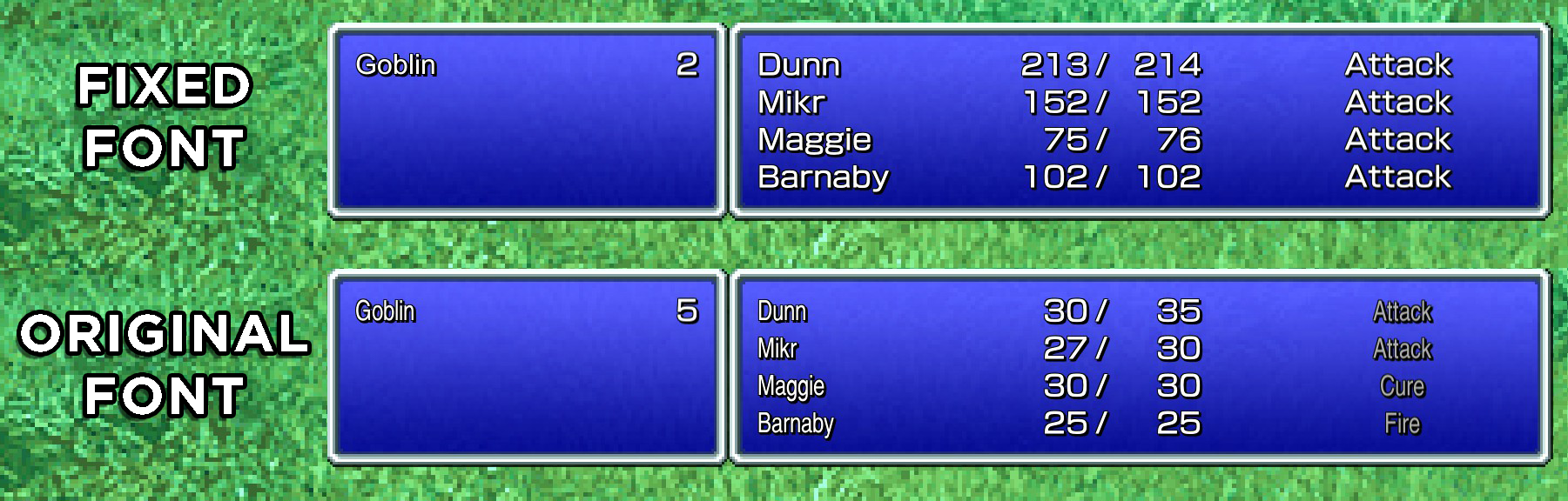
Ironically, they had a better Latin font _in the Japanese language version_ for all the genre loan abbreviations like MP/HP/LV etc., (https://terimaland.com/Memory/Steam_FinalFantasyPixelRemaste...) so that image is comparing the modded in Japanese Latin font vs the font the game includes by default.
(They also have a retro blocky "pixellated" font option iirc, which doesn't have the super narrow widths)
Standard Latin characters are half width. Full width latin characters do exist, but that’s not the difference we’re seeing here, if anything that would make the Latin font in the English release “quarter width” except that’s not a real thing that exists. It’s just an ultra condensed font, and the fix is replacing the font files with more standard fonts, not some kind of special font to treat half width as full width.
Realistically it’s only katakana that you can make this mixup on. My desktop IME will let me type カタカナ or (reluctantly) カタカナ, though it turns out iOS doesn’t have a way to type the half width kana, and IMEs have differing opinions on if they prefer full width digits, so you might see full width numbers like 5000。
I do find it interesting that the article lead goes with "computer scientist Louis Rosenberg" while if you click into the author profile it says:
> Dr. Louis B. Rosenberg is a computer scientist and current CEO of Unanimous AI, a California company focused on amplifying human intelligence using AI algorithms modeled on biological swarms.


reply